in event of nuclear attack, designated officials report to Diefenbunker

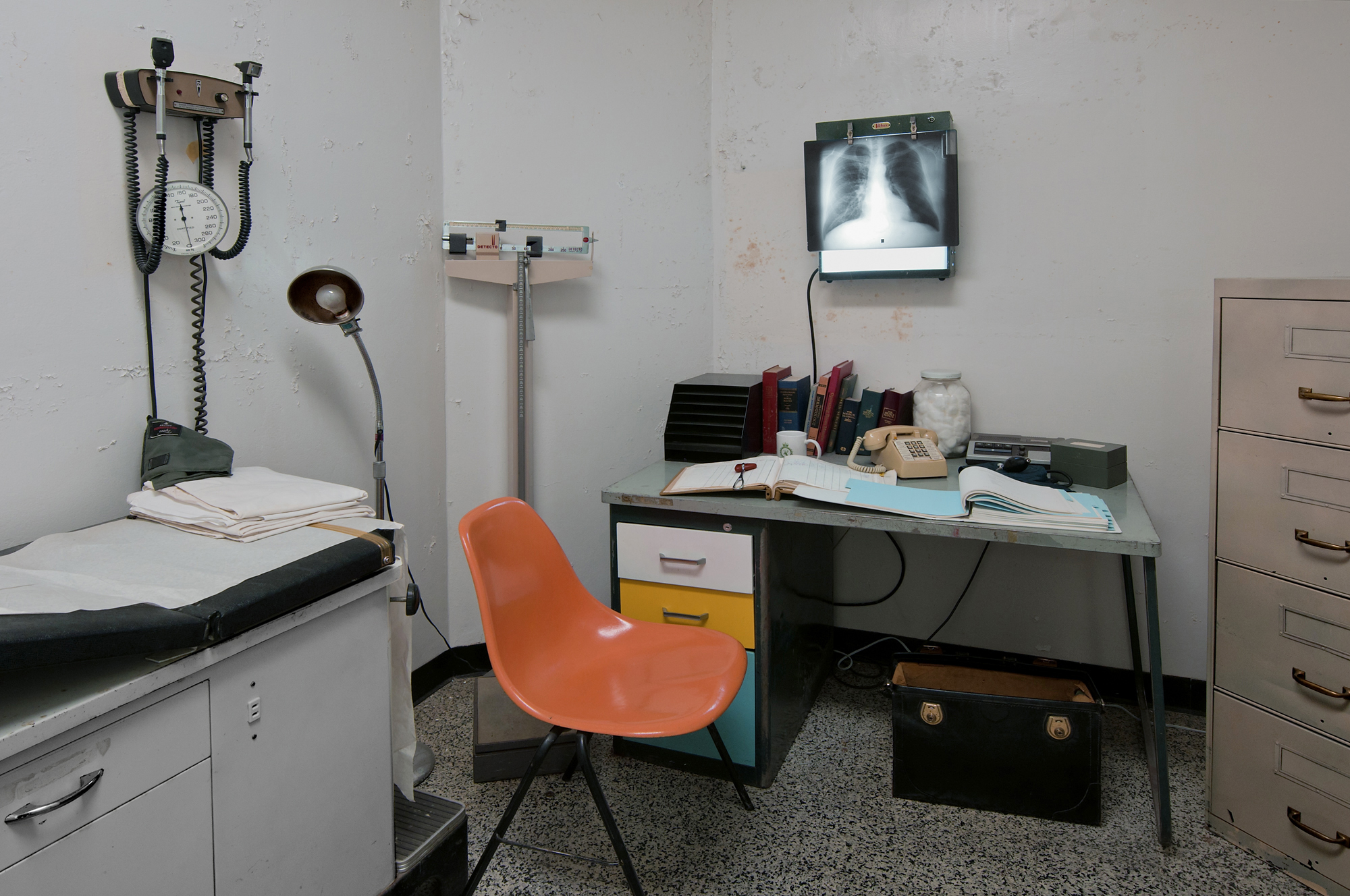
Examination Room, Medical Centre, Level 400, The Diefenbunker, Ottawa 2010

© Leslie Hossack

Exactly 50 years ago, in December 1961, Canada’s Central Emergency Government Headquarters, aka the Diefenbunker, became operational. During the Cold War, in the event of a nuclear attack, designated government officials would report to the bunker. Because they may have been exposed to radiation, they would first be directed to the decontamination area. Please see yesterday’s post for a photograph of the decontamination showers.

After leaving the decontamination chamber, officials entering the Deifenbunker would be checked out by medical staff before reporting for duty. The medical centre in the bunker was staffed by personnel from the Canadian National Defence Medical Centre.

Built secretly between 1959 and 1961 just outside of Ottawa, the Diefenbunker was nicknamed after Prime Minister John G. Diefenbaker. This massive underground complex contained office spaces, sleeping quarters, broadcasting facilities and decontamination chambers.

On August 21st 1958, Prime Minister Diefenbaker ordered the construction of the shelter. The Diefenbunker was designed for 535 people, with enough supplies to survive for 30 days. Inside the bunker, a CBC radio station provided a vital link to the Canadian public. A weather studio was equipped to monitor wind patterns and take radioactive readings. Other rooms – kitchens, bathrooms, food and waste storage, a hospital and a morgue – were dedicated to simple human survival. People entering the bunker would have had to go through a decontamination room with “radiac” equipment, showers and lead-lined clothing disposal bins.

Please visit the Parks Canada site for more information about The Diefenbunker.

officials directed to decontamination area

Shower, Decontamination Area, Level 400, The Diefenbunker, Ottawa 2010

© Leslie Hossack

Exactly 50 years ago, in December 1961, Canada’s Central Emergency Government Headquarters, aka the Diefenbunker, became operational. During the Cold War, in the event of a nuclear attack, designated government officials and staff would enter the bunker via the blast tunnel shown in yesterday’s post. Because they may have been exposed to radiation, they would first be directed to the decontamination area where they would be required to take a shower with their clothes on. After their wet contaminated clothes were removed and put in lead-lined containers, individuals needed to have a second shower before donning clean overalls and slippers, and proceeding to the medical centre.

Built secretly between 1959 and 1961 just outside of Ottawa, the Diefenbunker was nicknamed after Prime Minister John G. Diefenbaker. This massive underground complex contained office spaces, sleeping quarters, broadcasting facilities and decontamination chambers, such as the yellow shower area shown in the photograph above.

On August 21st 1958, Prime Minister Diefenbaker ordered the construction of the shelter. The Diefenbunker was designed for 535 people, with enough supplies to survive for 30 days. Inside the bunker, a CBC radio station provided a vital link to the Canadian public. A weather studio was equipped to monitor wind patterns and take radioactive readings. Other rooms – kitchens, bathrooms, food and waste storage, a hospital and a morgue – were dedicated to simple human survival. People entering the bunker would have had to go through a decontamination room with “radiac” equipment, showers and lead-lined clothing disposal bins.

Please visit the Parks Canada site for more information about The Diefenbunker.

Diefenbunker celebrates 50th anniversary

Blast Tunnel, The Diefenbunker, Ottawa 2010

© Leslie Hossack

Exactly 50 years ago, in December 1961, Canada’s Central Emergency Government Headquarters, aka the Diefenbunker, became operational. Today, Haute Vitrine launches a new series featuring photographs of Canada’s Cold War Museum, located in the Diefenbunker. Visitors enter by walking through the 378-foot-long blast tunnel seen in the photograph above. This tunnel is designed to allow the pressure wavefront caused by a nuclear blast to pass by the entrance doors of the bunker.

Built secretly between 1959 and 1961 just outside of Ottawa, the Diefenbunker was designed to protect government officials in the event of a nuclear attack. Nicknamed after Prime Minister John G. Diefenbaker, the Diefenbunker was a massive complex of office spaces, sleeping quarters, broadcasting facilities and decontamination chambers.

On August 21st 1958, Prime Minister Diefenbaker ordered the construction of the shelter at the height of the Cold War. The Central Emergency Government Headquarters was a four-storey underground shelter located west of Ottawa, near the village of Carp. Although its construction was to be kept secret, the size of the project forced Prime Minister Diefenbaker to acknowledge that the government was building a nuclear fallout shelter for the country’s leaders.

The Diefenbunker was designed for 535 people, with enough supplies to survive 30 days. The bunker entrance was located at a right angle midway down an open-ended tunnel. This design meant that an above-ground explosion would sweep through the tunnel without affecting the double airlock door at the front of the building. Shown in the photograph above is the view seen as you exit the bunker, turn left into the blast tunnel, and begin the climb back to the surface.

Please visit the Parks Canada site for more information about The Diefenbunker.

Today the Berlin Wall marks its 50th anniversary.

For almost thirty years the Berlin Wall divided a city and defined a generation.

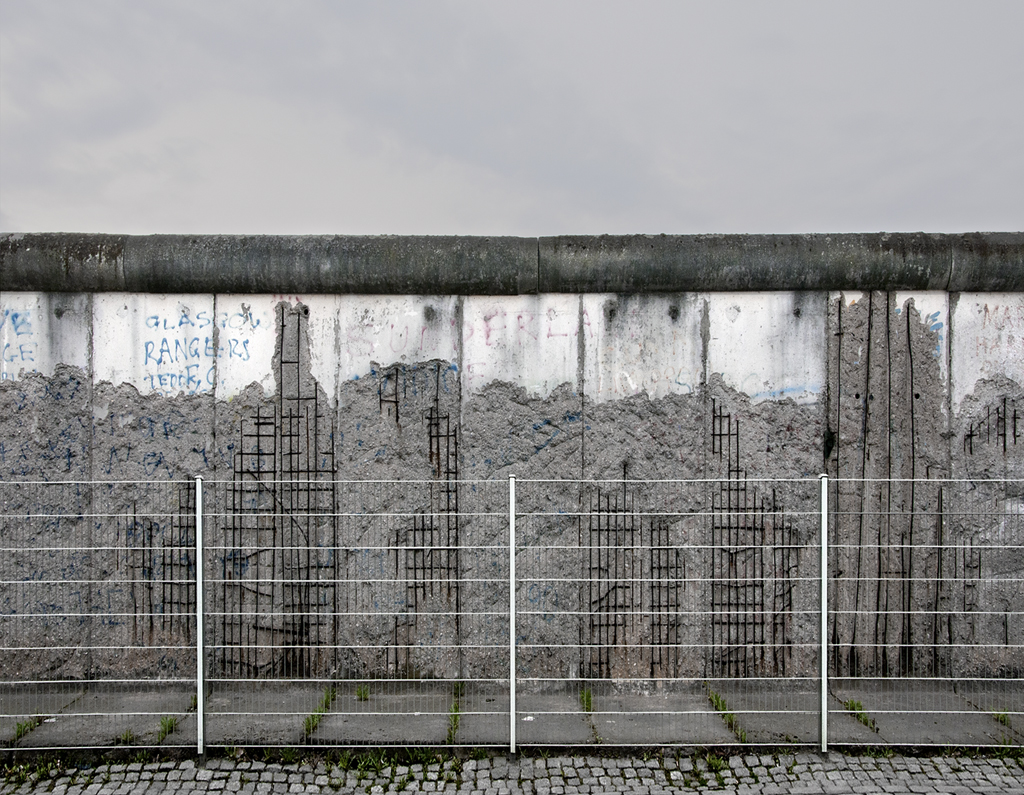
The Wall, Niederkirchner Strasse, Berlin 2010

© Leslie Hossack

At 2 a.m. on August 13th, 1961, East German soldiers began building the wall with barbed wire. Soon, West Berlin was enclosed by a fortified frontier 160 km long. Officially known as the Anti-fascist Protective Rampart, the wall was really put up to prevent East Germans from fleeing to the West. Eventually, the barbed wire was replaced with a concrete wall 3.6 metres high. There were up to 14 border crossings, including Checkpoint Charlie and the Brandenburg Gate.

For almost thirty years the Berlin Wall divided a city and defined a generation around the world. This photograph surveys one of the last remnants of the wall, an iconic relic of the Cold War protected for posterity behind a fence. It was badly damaged in 1989/90 by “wall-peckers” who attacked the wall with hammers during the nights after the opening of the frontier November 9th, 1989.

In Berlin today, little evidence of the wall remains. This section of the wall on Niederkirchner Strasse runs past the former site of the Nazi Security Headquarters created in 1939; this was also the headquarters of the SS. Unseen behind the viewer, still stands Göring’s gigantic Reich Aviation Ministry which was designed by Ernst Sagebiel and built in 1935-1936.

My photograph entitled The Wall, Niederkirchner Strasse is a construction, not a stitch. It measures eight feet long and is currently on view in my exhibition CITIES OF STONE – PEOPLE OF DUST at the Red Wall Gallery in Ottawa until September 2nd. This photograph is intended to simulate a walk along the Berlin Wall today, 50 years after it first appeared. I posted this image at 2 a.m. to coincide with the time that the Berlin Wall was born on August 13th, 1961.

August 12, 2011: The Berlin Wall marks its 50th anniversary tomorrow.

There are many people in the world who really don’t understand, or say they don’t, what is the great issue between the free world and the Communist world. Let them come to Berlin. … All free men, wherever they may live, are citizens of Berlin. And, therefore, as a free man, I take pride in the words “Ich bin ein Berliner.” – President John F. Kennedy, in a speech in West Berlin, 26 June 1963

  Berlin is the testicle of the West. When I want the West to scream, I squeeze on Berlin.
– Premier Nikita Krushchev, in a speech in Yugoslavia, 24 August 1963

Berlin Wall Detail # 9, from The Wall, Niederkirchner Strasse, Berlin 2010

The two image details shown here are taken from my photograph entitled The Wall, Niederkirchner Strasse. The original photograph is a construction, not a stitch. It measures eight feet long and is currently on view in my exhibition CITIES OF STONE – PEOPLE OF DUST at the Red Wall Gallery in Ottawa until September 2nd.

This photograph is intended to simulate a walk along the Berlin Wall today, 50 years after it first appeared. Tomorrow I will post the entire image at 2 a.m. to coincide with the time that the Berlin Wall was born on August 13th, 1961.

Berlin Wall Detail # 10, from The Wall, Niederkirchner Strasse, Berlin 2010

© Leslie Hossack

August 11: The Berlin Wall marks its 50th anniversary on Saturday.

Why would Krushchev put up a wall if he really intended to seize West Berlin? … This is his way out of his predicament. It’s not a very nice solution, but a wall is a hell of a lot better than a war. – President John F. Kennedy to an aide, 13 August 1961

In August 1961 a curtain was drawn aside to reveal an empty stage. To put it more bluntly, we lost certain illusions that had outlived the hopes underlying them . . . Ulbricht had been allowed to take a swipe at the Western super-power, and the United States merely winced with annoyance. – Willy Brandt in People and Politics, 1978

Berlin Wall Detail # 7, from The Wall, Niederkirchner Strasse, Berlin 2010

The two image details shown here are taken from my photograph entitled The Wall, Niederkirchner Strasse. The original photograph is a construction, not a stitch. It measures eight feet long and is currently on view in my exhibition CITIES OF STONE – PEOPLE OF DUST at the Red Wall Gallery in Ottawa until September 2nd.

This photograph is intended to simulate a walk along the Berlin Wall today, 50 years after it first appeared. I plan to post two different details everyday this week, leading up to Saturday when I will post the entire image at 2 a.m. to coincide with the time that the Berlin Wall was born on August 13th, 1961.

Berlin Wall Detail # 8, from The Wall, Niederkirchner Strasse, Berlin 2010

© Leslie Hossack

August 10, 2011: The Berlin Wall marks its 50th anniversary this week.

The construction workers of our capital are for the most part busy building apartment houses, and their working capacities are fully employed to that end. Nobody intends to put up a wall. – Walter Ulbricht in a press conference, 15 June 1961

Khrushchev is losing East Germany. He cannot let that happen. If East Germany goes, so will Poland and all of Eastern Europe. He will have to do something to stop the flow of refugees. Perhaps a wall. And we won’t be able to prevent it. – President John F. Kennedy to Deputy National Security Advisor Walt Rostow, August 1961

Berlin Wall Detail # 5 from The Wall, Niederkirchner Strasse, Berlin 2010

The two image details shown here are taken from my photograph entitled The Wall, Niederkirchner Strasse. The original photograph is a construction, not a stitch. It measures eight feet long and is currently on view in my exhibition CITIES OF STONE – PEOPLE OF DUST at the Red Wall Gallery in Ottawa until September 2nd.

This photograph is intended to simulate a walk along the Berlin Wall today, 50 years after it first appeared. I plan to post two different details everyday this week, leading up to Saturday when I will post the entire image at 2 a.m. to coincide with the time that the Berlin Wall was born on August 13th, 1961.

Berlin Wall Detail # 6, from The Wall, Niederkirchner Strasse, Berlin 2010

© Leslie Hossack

August 9, 2011: The Berlin Wall marks its 50th anniversary later this week.

So we’re stuck in this ridiculous situation. It seems silly for us to be facing an atomic war over a treaty preserving Berlin as the future capital of a reunified Germany when all of us know that Germany will probably never be reunified. -President John F. Kennedy to his aides, 1 June 1961

Berlin is the most dangerous place in the world. The USSR wants to perform an operation on this soft spot to eliminate this thorn, this ulcer. -Premier Nikita Krushchev to President John F. Kennedy at their Vienna Summit, June 1961

Berlin Wall Detail # 3, from The Wall, Niederkirchner Strasse, Berlin 2010

The two image details shown here are taken from my photograph entitled The Wall, Niederkirchner Strasse. The original photograph is a construction, not a stitch. It measures eight feet long and is currently on view in my exhibition CITIES OF STONE – PEOPLE OF DUST at the Red Wall Gallery in Ottawa until September 2nd.

This photograph is intended to simulate a walk along the Berlin Wall today, 50 years after it first appeared. I plan to post two different details everyday this week, leading up to Saturday when I will post the entire image at 2 a.m. to coincide with the time that the Berlin Wall was born on August 13th, 1961.

Berlin Wall Detail # 4, from The Wall, Niederkirchner Strasse, Berlin 2010

© Leslie Hossack

August 8, 2011: The Berlin Wall marks its 50th anniversary later this week.

The booming economy in West Germany, which is visible to every citizen of the GDR, is the primary reason that in the last ten years around two million people have left our republic.  – Walter Ulbricht to Premier Nikita Krushchev, 18 January 1961

West Berlin is a bone in the throat of Soviet-American relations … If Adenauer wants to fight, West Berlin would be a good place to begin the conflict.  – Premier Nikita Krushchev to U.S. Ambassador Llewellyn Thompson, 9 March 1961

Berlin Wall Detail # 1, from The Wall, Niederkirchner Strasse, Berlin 2010

The two image details shown here are taken from my photograph entitled The Wall, Niederkirchner Strasse. The original photograph is a construction, not a stitch. It measures eight feet long and is currently on view in my exhibition CITIES OF STONE – PEOPLE OF DUST at the Red Wall Gallery in Ottawa until September 2nd.

This photograph is intended to simulate a walk along the Berlin Wall today, 50 years after it first appeared. I plan to post two different details everyday this week, leading up to Saturday when I will post the entire image at 2 a.m. to coincide with the time that the Berlin Wall was born on August 13th, 1961.

Berlin Wall Detail # 2, from The Wall, Niederkirchner Strasse, Berlin 2010

© Leslie Hossack