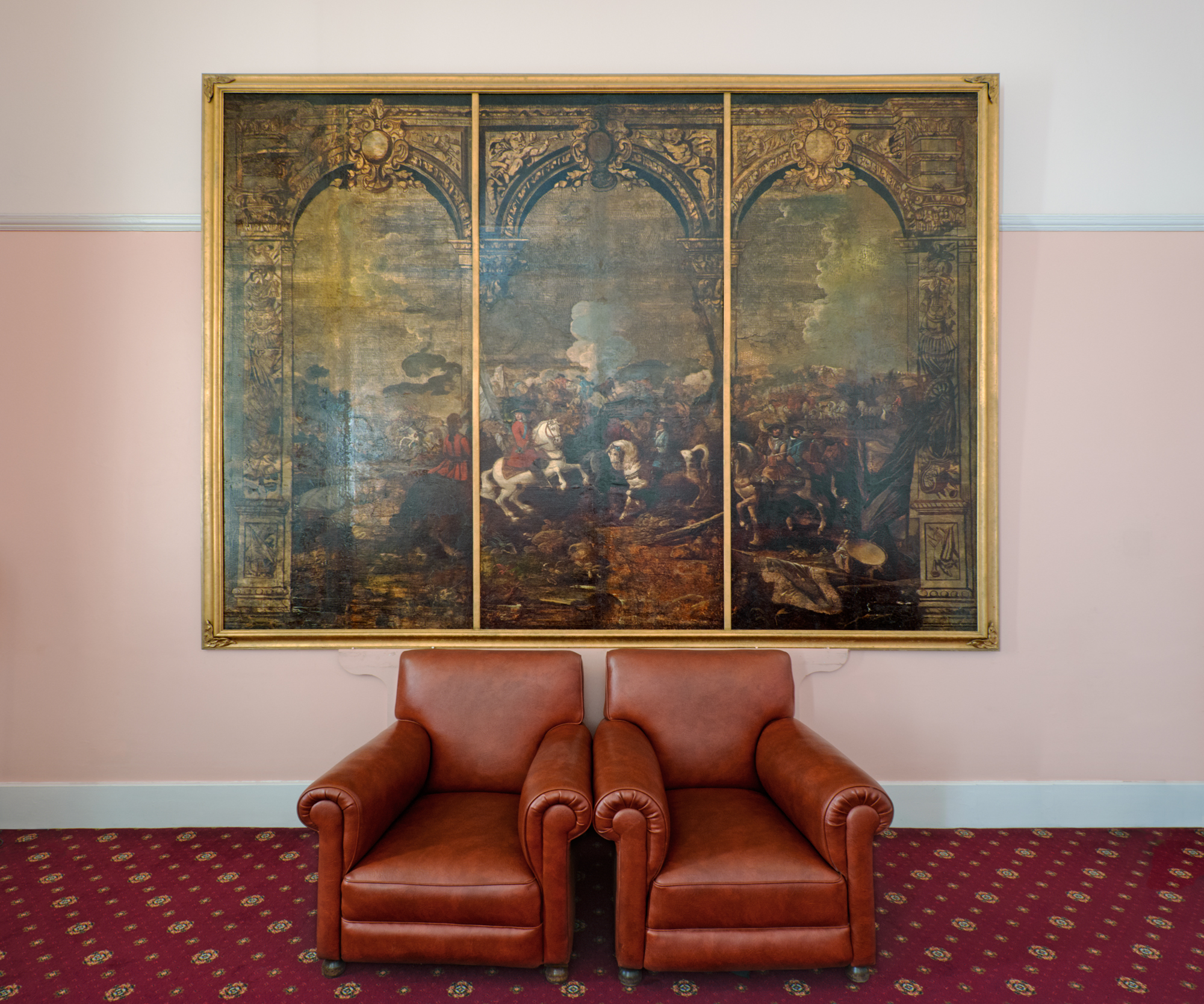
Marlborough Room, Royal Military College, Sandhurst 2014
© Leslie Hossack
At the beginning of 1929, Winston Churchill’s political career appeared to be at its zenith. However, Stanley Baldwin’s government was defeated in May, and Churchill resigned as Chancellor of the Exchequer. Thus began his “Wilderness Years.” Throughout this period, he continued to represent Epping in the House of Commons, but not as a member of the governing party. From the spring of 1929 until the spring of 1939, Churchill would not hold a cabinet post.
In August 1929, Winston set out on a North American tour with his son Randolph, his brother Jack and his nephew Johnnie. The four travelled across Canada by train to Vancouver and Victoria. Churchill enjoyed the scenery en route and painted various sights, including Lake Louise. The group then travelled south to California. By the end of October, Churchill’s party had reached New York City where he observed the Wall Street Crash first hand. He himself lost £17,000, at a time when he could ill afford a financial set back.
Once again, Churchill would turn to writing as his main source of income. He received an advance of £20,000 for Marlborough, a book he wanted to write about his ancestor John Churchill, the 1st Duke of Marlborough. Winston had been born in Blenheim Palace, which was given to the 1st Duke of Marlborough in gratitude for his victory at the Battle of Blenheim in 1705.
Shown above is the Marlborough Room, Royal Military College, Sandhurst. This room, named after the 1st Duke, features a triptych on leather of the Battle of Blenheim, painted by Horensburg. Now the room is used as an officer cadet anteroom where one of the companies of cadets assembles. Winston Churchill was a cavalry cadet at Sandhurst from September 1893 to December 1894.
The image featured above is part of the limited edition collector’s portfolio created by Leslie Hossack to mark the 50th anniversary of the death of Sir Winston Churchill. She presents locations that chart Churchill’s personal and political life, from his birth at Blenheim Palace in 1874 until his death in London in 1965. THE CHURCHILL PHOTOGRAPHS are part of Hossack’s larger body of work that explores Nazi architecture in Berlin, Stalinist structures in Moscow, contested sites in Jerusalem, a Cold War bunker in Ottawa, NATO’s Headquarter Camp in Kosovo, and buildings linked to the Japanese Canadian internment during World War II.
To view more photographs, please visit Leslie’s website. lesliehossack.com

 HAUTE VITRINE