August 11: The Berlin Wall marks its 50th anniversary on Saturday.

Why would Krushchev put up a wall if he really intended to seize West Berlin? … This is his way out of his predicament. It’s not a very nice solution, but a wall is a hell of a lot better than a war. – President John F. Kennedy to an aide, 13 August 1961

In August 1961 a curtain was drawn aside to reveal an empty stage. To put it more bluntly, we lost certain illusions that had outlived the hopes underlying them . . . Ulbricht had been allowed to take a swipe at the Western super-power, and the United States merely winced with annoyance. – Willy Brandt in People and Politics, 1978

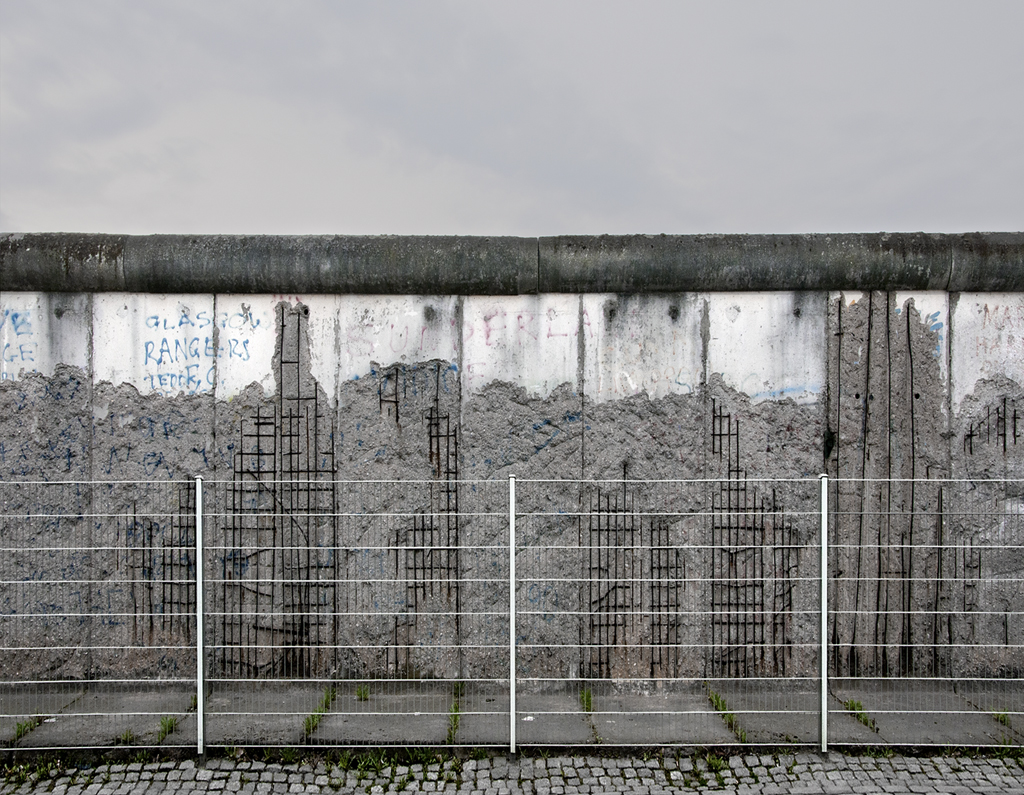
Berlin Wall Detail # 7, from The Wall, Niederkirchner Strasse, Berlin 2010

The two image details shown here are taken from my photograph entitled The Wall, Niederkirchner Strasse. The original photograph is a construction, not a stitch. It measures eight feet long and is currently on view in my exhibition CITIES OF STONE – PEOPLE OF DUST at the Red Wall Gallery in Ottawa until September 2nd.

This photograph is intended to simulate a walk along the Berlin Wall today, 50 years after it first appeared. I plan to post two different details everyday this week, leading up to Saturday when I will post the entire image at 2 a.m. to coincide with the time that the Berlin Wall was born on August 13th, 1961.

Berlin Wall Detail # 8, from The Wall, Niederkirchner Strasse, Berlin 2010

© Leslie Hossack

August 10, 2011: The Berlin Wall marks its 50th anniversary this week.

The construction workers of our capital are for the most part busy building apartment houses, and their working capacities are fully employed to that end. Nobody intends to put up a wall. – Walter Ulbricht in a press conference, 15 June 1961

Khrushchev is losing East Germany. He cannot let that happen. If East Germany goes, so will Poland and all of Eastern Europe. He will have to do something to stop the flow of refugees. Perhaps a wall. And we won’t be able to prevent it. – President John F. Kennedy to Deputy National Security Advisor Walt Rostow, August 1961

Berlin Wall Detail # 5 from The Wall, Niederkirchner Strasse, Berlin 2010

The two image details shown here are taken from my photograph entitled The Wall, Niederkirchner Strasse. The original photograph is a construction, not a stitch. It measures eight feet long and is currently on view in my exhibition CITIES OF STONE – PEOPLE OF DUST at the Red Wall Gallery in Ottawa until September 2nd.

This photograph is intended to simulate a walk along the Berlin Wall today, 50 years after it first appeared. I plan to post two different details everyday this week, leading up to Saturday when I will post the entire image at 2 a.m. to coincide with the time that the Berlin Wall was born on August 13th, 1961.

Berlin Wall Detail # 6, from The Wall, Niederkirchner Strasse, Berlin 2010

© Leslie Hossack

August 9, 2011: The Berlin Wall marks its 50th anniversary later this week.

So we’re stuck in this ridiculous situation. It seems silly for us to be facing an atomic war over a treaty preserving Berlin as the future capital of a reunified Germany when all of us know that Germany will probably never be reunified. -President John F. Kennedy to his aides, 1 June 1961

Berlin is the most dangerous place in the world. The USSR wants to perform an operation on this soft spot to eliminate this thorn, this ulcer. -Premier Nikita Krushchev to President John F. Kennedy at their Vienna Summit, June 1961

Berlin Wall Detail # 3, from The Wall, Niederkirchner Strasse, Berlin 2010

The two image details shown here are taken from my photograph entitled The Wall, Niederkirchner Strasse. The original photograph is a construction, not a stitch. It measures eight feet long and is currently on view in my exhibition CITIES OF STONE – PEOPLE OF DUST at the Red Wall Gallery in Ottawa until September 2nd.

This photograph is intended to simulate a walk along the Berlin Wall today, 50 years after it first appeared. I plan to post two different details everyday this week, leading up to Saturday when I will post the entire image at 2 a.m. to coincide with the time that the Berlin Wall was born on August 13th, 1961.

Berlin Wall Detail # 4, from The Wall, Niederkirchner Strasse, Berlin 2010

© Leslie Hossack

August 8, 2011: The Berlin Wall marks its 50th anniversary later this week.

The booming economy in West Germany, which is visible to every citizen of the GDR, is the primary reason that in the last ten years around two million people have left our republic.  – Walter Ulbricht to Premier Nikita Krushchev, 18 January 1961

West Berlin is a bone in the throat of Soviet-American relations … If Adenauer wants to fight, West Berlin would be a good place to begin the conflict.  – Premier Nikita Krushchev to U.S. Ambassador Llewellyn Thompson, 9 March 1961

Berlin Wall Detail # 1, from The Wall, Niederkirchner Strasse, Berlin 2010

The two image details shown here are taken from my photograph entitled The Wall, Niederkirchner Strasse. The original photograph is a construction, not a stitch. It measures eight feet long and is currently on view in my exhibition CITIES OF STONE – PEOPLE OF DUST at the Red Wall Gallery in Ottawa until September 2nd.

This photograph is intended to simulate a walk along the Berlin Wall today, 50 years after it first appeared. I plan to post two different details everyday this week, leading up to Saturday when I will post the entire image at 2 a.m. to coincide with the time that the Berlin Wall was born on August 13th, 1961.

Berlin Wall Detail # 2, from The Wall, Niederkirchner Strasse, Berlin 2010

© Leslie Hossack
Jesse Owens’ Room, Meissen House, 1936 Olympic Village

75 years ago this week, Jesse Owens won four gold medals at the Berlin Games.

Jesse Owens’ Room, Meissen House, 1936 Olympic Village, Berlin 2010

© Leslie Hossack

During the Berlin Olympics, male competitors were housed in the Olympic Village, located about 14 km west of the Olympic Stadium. There were 140 houses for the athletes, and each house was named after a German city. Jesse Owens stayed in Meissen House. The white bungalows with red tile roofs contained 13 bedrooms, with two athletes per room. According to the official report of the 1936 Games, “the double-bed rooms were spacious, elegantly designed and lavishly decorated and furnished.”

Soon after he moved into the Olympic Village, Jesse Owens was visited by a German shoe manufacturer named Adi Dassler. Owens was persuaded by Dassler to compete wearing the athletic shoes that he was producing in a small company in Bavaria. This was the first sponsorship for an African-American athlete. As a result, Adi Dassler’s business expanded, and he eventually founded Adidas in 1948.

American Olympian Jesse Owens was born James Cleveland Owens, in 1913 in Alabama. The son of a sharecropper and the grandson of a slave, he went on to become the star of the Berlin Games. There he won four gold medals: the 100 metre sprint on August 3rd; the long jump on August 4th; the 200 metre sprint on August 5th; and the 4 x 100 metre relay on August 9th. Owens’ record of four gold medals at a single Olympic Games stood for almost 50 years, until Carl Lewis won gold medals in the same four events in 1984.

Italian Dining Room, House of Nations, 1936 Olympic Village

The Italian dining room, one of the largest in Berlin’s Olympic Village, catered to the 240 men on the Italian team.

Italian Dining Room, House of Nations, 1936 Olympic Village, Berlin 2010

© Leslie Hossack
The 1936 Olympic Village is located about 14km west of the Olympic Stadium, in the German countryside. This is where all the male athletes were housed, while the 328 female competitors were accommodated in Friesen House adjacent to the main stadium. In all, approximately 4,000 athletes from 49 nations took part in the Summer Games.

The village was laid out in the shape of a map of Germany with the House of Nations, or main dining hall, centrally located. This large, circular three-story building contained 38 separate dining rooms. The Italian dining room shown here is one of the two large halls located on the ground floor, and it catered to the 240 men on the Italian team.

The Olympic Village, constructed by the German Army under the direction of Captain Wolfgang Fuerstner, received high praise. However, Captain Fuerstner was demoted because of his Jewish ancestry, and tragically, two days after the Games, he went to his barracks and shot himself.

Following the 1936 Olympics, the village became home to a German infantry school, and the House of Nations was turned into a hospital. After WW II, the Soviet army took over the site and used it until 1992. Following their withdrawal, the village was abandoned. More recently, it has been protected by a preservation order, and DKB (The German Credit Bank) is now overseeing the historic restoration and sustainable development of the 1936 Berlin Olympic Village.

Architect, House of Nations: Georg Steinmetz                  Date: 1934-1936

Architect, Olympic Village: Werner March                        Date: 1934-1936

Swimming Stadium and Pool, 1936 Olympic Games

Perhaps the best-known account of the 1936 Summer Games is Leni Riefenstah’s film Olympia, with its celebrated diving sequence.

Swimming Stadium and Pool, 1936 Olympic Games, Berlin 2010

© Leslie Hossack

The swimming stadium is positioned just to the north of the 1936 Berlin Olympic Stadium. It is one of many competition venues located on the 130-hectare site of the Reichssportfeld.

Like the main arena, the swimming stadium is clad in limestone. It holds 6,500 spectators, but during the Olympics thousands more were accommodated on temporary stands. The stadium contains a swimming pool measuring 20 x 50 metres, and a 20 x 20 metre diving pool. Here, Marjorie Gestring of the United States won the women’s three-metre springboard diving event at the age of 13 years, 268 days. She was the youngest person to win a gold medal, and that record still stands today.

Another young swimmer, 15-year-old Austrian champion Ruth Langer, refused to compete in the 1936 Olympics. Although anti-Semitism was strong in Austria, officials had named Ruth, Judith Deutsch and Lucie Goldner to their swimming team. The three women, all Jews, refused to take part in the Olympics, saying: “We do not boycott Olympia, but Berlin.” However, there was no mass international boycott of the games.

Perhaps the best-known account of the 1936 Summer Games is the full-length film Olympia, directed by Leni Riefenstahl. The diving sequence shot at the swimming stadium is one of the most celebrated parts of this notorious film that was awarded a Gold Medal by the IOC. Although Riefenstahl was cleared by a denazification court in 1952 of charges of Nazi collaboration, she was haunted for the rest of her life by questions about her role in creating propaganda for Hitler and the Nazis.

Architect: Werner March          Date: 1936

CITIES OF STONE – PEOPLE OF DUST

My new exhibition CITIES OF STONE – PEOPLE OF DUST opens tomorrow, August 5th, at the Red Wall Gallery in Ottawa.

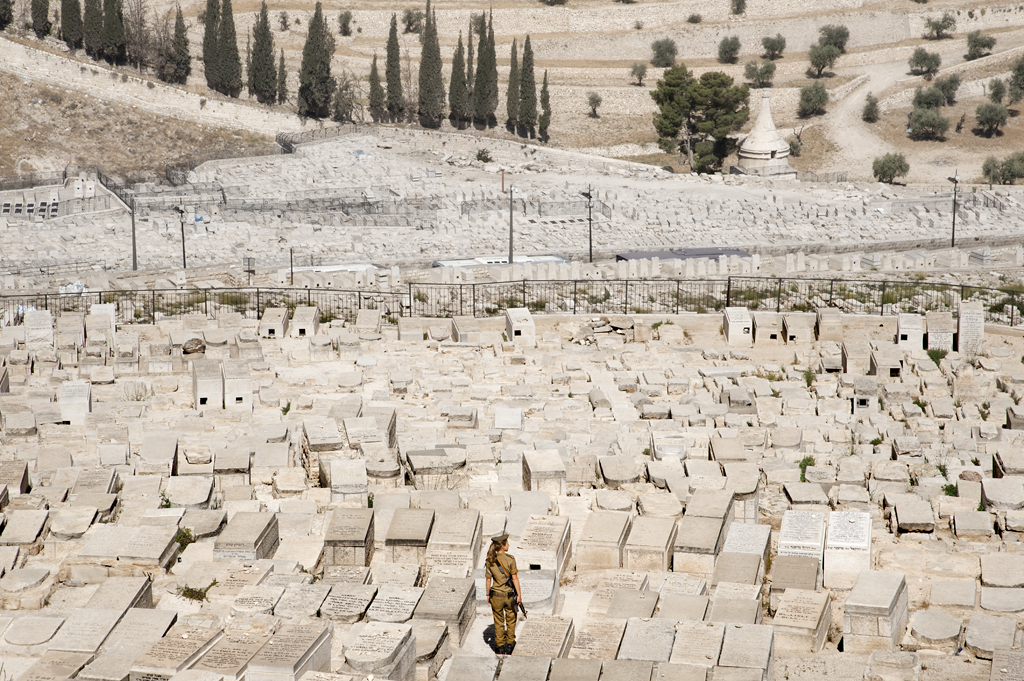
Jewish Cemetery, Mount of Olives, Jerusalem 2011

© Leslie Hossaack

CITIES OF STONE – PEOPLE OF DUST is an exhibition of my photographs opening tomorrow at the Red Wall Gallery in the School of the Photographic Arts: Ottawa, 168 Dalhousie Street. The vernissage takes place on August 5th from 18:00-21:00, and the show runs through to September 2nd, 2011.

After completing a series of photographic studies of Nazi architecture and the Berlin Wall, I felt compelled to travel to Israel – another charged landscape. Put simply, Berlin was my springboard to Israel, both literally and figuratively.

Loss, longing and lamentation: loss of land, loss of innocence, loss of humanity, loss of freedom, loss of life; these notions haunted me in Berlin and Israel. And underscoring all my work is the issue of inclusion and exclusion. This question is posed by every image, but it is perhaps most obvious in my photographs of walls: the Berlin Wall, the Western or Wailing Wall, the walls of the Old City of Jerusalem, the walls of the ancient fortress at Masada, and the Israeli Separation Wall. All my life I have been disturbed by the duality of inclusion and exclusion.

After returning home from Israel this May, I was both intrigued and perplexed by what I had witnessed. I do not pretend to understand the horrors of the Holocaust, the long and complex histories of the Holy City, or the current politics of the Israeli-Palestinian conflict. It is not my intention to suggest solutions or to find fault. However, I do hope that CITIES OF STONE – PEOPLE OF DUST will raise awareness and pose questions. The question that kept running through my mind as I explored historic Berlin and modern Israel was: at what cost?

PRESS RELEASE

Cauldron, 1936 Olympic Stadium

The 1936 Berlin Olympics marked the first time that a torch relay was run from Olympia to the site of the games.

Cauldron, 1936 Olympic Stadium, Berlin 2010

© Leslie Hossack

The 1936 Olympic Games were the largest to date; they involved approximately 4,000 athletes from 49 nations, and 3.8 million spectators. It was the first time that the games received worldwide radio coverage, and there were TV broadcasts as well. The Nazis were masters of symbols, pageantry, communication and propaganda.

The Berlin Olympics also marked the first time ever that a torch relay was run from Olympia to the site of the games. The cauldron, located just inside the Marathon Gate of the Olympic Stadium, is Germanic in design with its clean, unadorned lines. Like all Nazi architecture, it is intended to look durable, permanent, timeless. Hitler decreed that the Olympic Stadium be constructed entirely of German materials, and this was true for the cauldron as well, which is made of steel on concrete.

Clearly visible in this photograph is the new roof of the stadium, added during the 2000-2004 modernization. The cantilevered construction is made up of a steel framework covered by a membrane, except for the outermost 13 metres which are glazed. Integral to this new roof are state of the art lighting and sound systems.

The renovated stadium now seats 74,228 people, not 100,000 as it did originally. On the right hand side of this image you can see the VIP boxes which look the same as they did when Reich Chancellor Adolf Hitler stood there, in the so-called Führer’s box, and officially opened the Berlin Olympic Games.

Architect: Werner March                         Date: 1936

Conversion Architects: GMP                  Date: 2000-2004

East Gate, 1936 Olympic Stadium

75 years ago, in August 1936, the XI Games took place in the Berlin Olympic Stadium.


East Gate, 1936 Olympic Stadium, Berlin 2010

© Leslie Hossack

The East Gate of the stadium, also known as the Olympic Gate, is made up of the Bavarian Tower and the Prussian Tower; together they support the Olympic Rings. Although modernized in 2000-2004, the stadium as seen in this photograph looks much as it did for the XI Olympic Games.

In 1933, Hitler personally intervened in the design of the stadium; he had his architect Albert Speer modify its outward appearance to keep it more in line with the Colosseum in Rome. The Berlin stadium, made of reinforced concrete, was covered with a veneer of limestone at Speer’s suggestion. There are 136 columns supporting the two-story arcade around the outside of the oval arena that held 100,000 spectators.

Architecture in The Third Reich was used to express the power of the state, and massive buildings were designed to symbolize Germany’s international standing. Hitler said he wanted to see eternal works built in Berlin, “comparable only to Ancient Egypt, Babylon and Rome.” The Nazis used the Olympics as a showcase for the National Socialist dictatorship; however, these games are now often referred to as the Propaganda Games. At the same time as Hitler was opening the games on August 1st, 1936, forced labour was being used only 35 km away to build Sachsenhausen Concentration Camp.

After WW II, the British occupied the Olympic site until 1994. Following the recent renovations, the stadium hosted the 2006 FIFA World Cup and it is now home to Hertha BSC, Berlin’s soccer club.

Architect: Werner March               Date: 1936

Conversion Architects: GMP        Date: 2000-2004