Israeli Soldiers Outside the Walls of the Old City

“the protests created a symbolic yet very real ‘threat’ to the Israeli bubble”

Soldiers Outside the Walls of the Old City, Jerusalem 2011

© Leslie Hossack

These young soldiers are sitting outside the walls of the Old City, not far from the Jaffa Gate. Built in the 16th century, the city walls have eight gates, seven of which are still in use. Until the 1870s, the gates were closed everyday from sunset until sunrise. The soldiers here are members of the Israel Defense Forces (IDF). National military service is mandatory for all Israeli citizens over the age of 18; men serve for three years and women for two.

This photograph was taken just before the back-to-back celebrations of Memorial Day and Independence Day. May 14th, 1948 marks the day Israel became an independent state. However, Independence Day is celebrated in Israel according to the Hebrew calendar; therefore, it fell on May 10th in 2011, and will fall on April 26th in 2012.

Palestinians observe Al-Naqba Day (Day of Catastrophe) on May 15th, the day after Israeli Independence Day. During the war in 1948, over 700,000 Palestinians fled or were expelled from Palestine, and the vast majority of these refugees have been denied the right of return. On May 15th, 2011, thousands of flag-carrying, non-violent Palestinians gathered at Israel’s borders to protest the creation of the State of Israel and their expulsion from Palestine.

“This Nakba day, unlike previous Nakba days, constituted a regional, synchronized act of awakening… For the general Israeli public, the protests created a symbolic yet very real ‘threat’ to the Israeli bubble” (Mahdi Sabbagh, May 22nd, 2011, 972 Magazine)
Mount of Olives, Israel

“It’s hard to evaluate the full cost that has been taken from us with their death.”

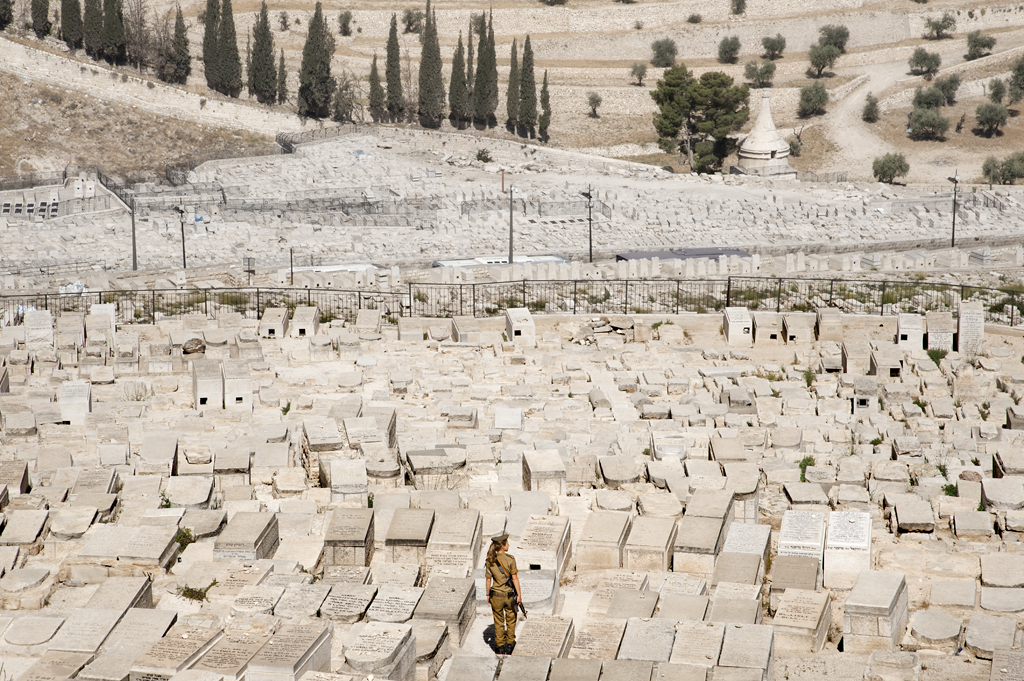
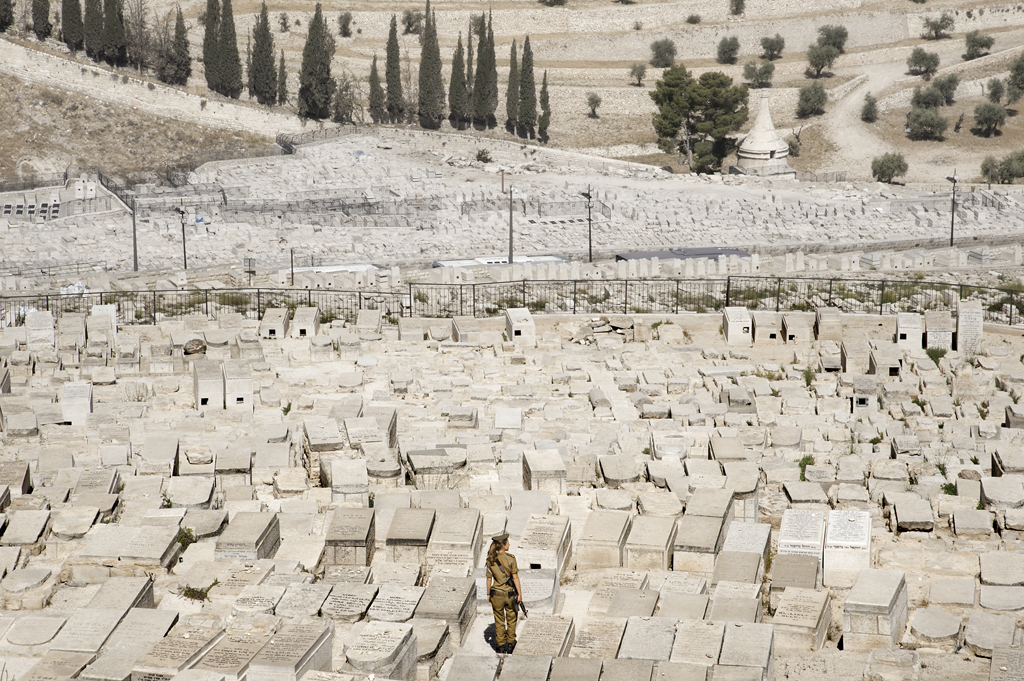
Jewish Cemetery, Mount of Olives, Jerusalem 2011

© Leslie Hossack

This ancient Jewish cemetery on the Mount of Olives is the oldest continuously used cemetery in the world; over 150,000 people have been buried here. The steep hillside, looking out over the Valley of Jehoshaphat, is also home to the Tombs of the Prophets: Haggai, Zachariah and Malachi. Jews believe that this is where God will start to redeem the dead when the Messiah returns on the Day of Judgment.

Walking down the path from the top of the Mount of Olives toward the Old City of Jerusalem, one passes many churches, the last one being the Basilica of Agony. Beside it is the beautiful Garden of Gethsemane which contains many of the world’s oldest olive trees, including some that are over 2,000 years old. It is believed that Jesus prayed here the night before his arrest.

This photograph was taken on Memorial Day, shortly before the 11:00 a.m. siren sounded across Israel. At that moment, cars stopped and people stood still to pay their respects to Israel’s fallen soldiers. Memorial Day (officially known as Fallen Soldiers and Victims of Terrorism Remembrance Day) starts the evening before with a ceremony at the Western Wall, and it ends the next evening at 8:00 p.m. when a torch is light at Mount Herzl Cemetery to mark the beginning of Independence Day.

In his speech at the Memorial Day ceremony, Prime Minister Benjamin Netanyahu said: “22,867 of our sons and daughters fell in Israel’s wars. It’s hard to evaluate the full cost that has been taken from us with their death.” In this photograph, the woman standing alone on the Mount of Olives is one of approximately 176,500 currently active members of the Israeli Defense Forces.

Yad Vashem, Israel

“displacement, concentration, deportation and extermination”

North Terrace, Holocaust History Museum, Yad Vashem, Jerusalem 2011

© Leslie Hossack

In 1953, Yad Vashem was established as an institution “dedicated to the study and commemoration of Jewish annihilation at the hands of the Nazis.” (Joan Ockman, A Place in the World for a World Displaced) Located atop the Mount of Remembrance, the 45-acre site includes research centres, memorials and museums. Yad Vashem Director Avner Shalev writes: “We wished to call visitors attention to the fact that the Holocaust spanned the entire European continent, that the process was set in motion in Northern Africa, and that it threatened to reach the Middle East. Wherever the Germans came, the Jews faced the same process: displacement, concentration, deportation and extermination.” (Building a Holocaust Museum in Jerusalem)

The museum was designed by internationally acclaimed architect Moshe Safdie whose other works include the National Gallery of Canada in Ottawa. Safdie’s museum is a 600-foot long, triangular, sky light tunnel made of concrete. According to municipal law, all buildings must be faced with local Jerusalem stone. This 1918 stone ordinance dates back to the British Mandate in Palestine, and Safdie had to get special permission to use concrete rather than limestone for the Holocaust History Museum.

This photograph shows visitors standing on the terrace at the end of the tunnel-like museum, looking out toward Jerusalem. In The Architecture of Memory, Safdie writes about the power of emerging into light. “For the new museum, cutting through the mountains and bursting northward, dramatically cantilevering the structure over the Jerusalem pine forest to provide views of the hills beyond took this life-affirming experience to another level.”

Architect:  Moshe Safdie     Date:  2005

from Paris to Berlin & Berlin to Jerusalem

Memorial to the Martyrs of the Deportation, Paris 2009

Memorial to the Murdered Jews of Europe, Berlin 2010

© Leslie Hossack

Having completed a major study of change and continuity in Paris in 2009, I travelled to Berlin in 2010 to continue my urban explorations. Somehow, Paris led to Berlin, and Berlin led to Jerusalem.

My journey to Israel in 2011 really started in Berlin. After completing a series of photographic studies of Nazi architecture and the Berlin Wall, I felt compelled to travel to Israel – another charged landscape. Put simply, I wanted to explore the link between historic Berlin and modern Israel. Berlin was my springboard to Israel, both literally and figuratively.

In both places, I was fascinated by the theme of loss, longing and lamentation – individual and collective. Loss of land, loss of innocence, loss of humanity, loss of freedom, loss of life: these notions haunted me in Berlin and in Israel. For me, the power of these iconic locations lies in the responses that they elicit from ordinary individuals.

After returning home from Israel, I was both intrigued and perplexed by what I had seen while observing everyday life in Jerusalem. I wanted to make some sense out of what I had witnessed. I do not pretend to understand the horrors of the Holocaust, the long and complex histories of the Holy City, or the current politics of the Israeli-Palestinian conflict.

However, the one question that kept running through my mind as I explored historic Berlin and modern Israel was: at what cost?

CITIES OF STONE – PEOPLE OF DUST

My new exhibition CITIES OF STONE – PEOPLE OF DUST opens tomorrow, August 5th, at the Red Wall Gallery in Ottawa.

Jewish Cemetery, Mount of Olives, Jerusalem 2011

© Leslie Hossaack

CITIES OF STONE – PEOPLE OF DUST is an exhibition of my photographs opening tomorrow at the Red Wall Gallery in the School of the Photographic Arts: Ottawa, 168 Dalhousie Street. The vernissage takes place on August 5th from 18:00-21:00, and the show runs through to September 2nd, 2011.

After completing a series of photographic studies of Nazi architecture and the Berlin Wall, I felt compelled to travel to Israel – another charged landscape. Put simply, Berlin was my springboard to Israel, both literally and figuratively.

Loss, longing and lamentation: loss of land, loss of innocence, loss of humanity, loss of freedom, loss of life; these notions haunted me in Berlin and Israel. And underscoring all my work is the issue of inclusion and exclusion. This question is posed by every image, but it is perhaps most obvious in my photographs of walls: the Berlin Wall, the Western or Wailing Wall, the walls of the Old City of Jerusalem, the walls of the ancient fortress at Masada, and the Israeli Separation Wall. All my life I have been disturbed by the duality of inclusion and exclusion.

After returning home from Israel this May, I was both intrigued and perplexed by what I had witnessed. I do not pretend to understand the horrors of the Holocaust, the long and complex histories of the Holy City, or the current politics of the Israeli-Palestinian conflict. It is not my intention to suggest solutions or to find fault. However, I do hope that CITIES OF STONE – PEOPLE OF DUST will raise awareness and pose questions. The question that kept running through my mind as I explored historic Berlin and modern Israel was: at what cost?

PRESS RELEASE