Charting Churchill: The Cenotaph, Whitehall, London

The Cenotaph, Whitehall, London 2014 by Leslie Hossack

The Cenotaph, Whitehall, London 2014

© Leslie Hossack

In 1915, Winston Churchill resigned as First Lord of the Admiralty, after the failure of the Dardanelles and Gallipoli campaigns that he had championed. He remained in the cabinet, in the lowly post of Chancellor of the Duchy of Lancaster. He was somewhat despondent but soon, while at Hoe Farm, he took up painting, a pastime that would bring him pleasure for the rest of his life.

However, as always, Winston craved action. In November 1916, when he was a 42-year-old married man with three small children, he resigned from the cabinet and went to France to command the Royal Scots Fusiliers in the trenches. Here he seemed to be seeking solace and redemption. After six months, Churchill returned to London and the House of Commons, still representing Dundee. In July 1917 and in December 1918, he was again elected there.

The year 1918 marked the birth of the Churchills’ fourth child, Marigold Frances. It also signaled the end of Word War I on Armistice Day, November 11th 1918. During the conflict, the British Empire suffered over 1,00,000 military deaths. Fortunately, Winston was not one of them. The Cenotaph, shown above, was completed in 1919 and commemorated the losses during Word War I. Eventually, it was also consecrated to the memory of individuals who died during World War II. Over his long career of public service, in the military and in the House of Commons, Winston Churchill attended many memorial services at the Cenotaph on Whitehall.

The image featured above is part of the limited edition collector’s portfolio created by Leslie Hossack to mark the 50th anniversary of the death of Sir Winston Churchill. She presents locations that chart Churchill’s personal and political life, from his birth at Blenheim Palace in 1874 until his death in London in 1965. THE CHURCHILL PHOTOGRAPHS are part of Hossack’s larger body of work that explores Nazi architecture in Berlin, Stalinist structures in Moscow, contested sites in Jerusalem, a Cold War bunker in Ottawa, NATO’s Headquarter Camp in Kosovo, and buildings linked to the Japanese Canadian internment during World War II.

To view more photographs, please visit Leslie’s website.  lesliehossack.com

Charting Churchill: Admiralty Arch, London

Admiralty Arch, The Mall, London 2014 by Leslie Hossack

Admiralty Arch, The Mall, London 2014

© Leslie Hossack

In October 1911, Winston Churchill was appointed First Lord of the Admiralty. This was a cabinet post that he relished, and in many ways he had been preparing for it throughout his entire life. In this role, Churchill made many significant decisions in the years leading up to the outbreak of World War I, in August 1914. However, in 1915 he proposed the Dardanelles and Gallipoli campaigns that failed and ultimately lead to his resignation as First Lord of the Admiralty in May 1915.

In 1912, early in Churchill’s tenure at the Admiralty, construction of the Admiralty Arch was completed. King Edward VII commissioned the building in memory of his mother, Queen Victoria. The Latin inscription across the top reads: “In the tenth year of King Edward VII, to Queen Victoria, from most grateful citizens, 1910.” During Churchill’s time, Admiralty Arch contained offices and was connected to the Old Admiralty Building via a bridge that can be seen on the right side of the above photograph. To this day, Admiralty Arch provides a ceremonial entrance from Trafalgar Square onto The Mall and along to Buckingham Palace.

The image featured above is part of the limited edition collector’s portfolio created by Leslie Hossack to mark the 50th anniversary of the death of Sir Winston Churchill. She presents locations that chart Churchill’s personal and political life, from his birth at Blenheim Palace in 1874 until his death in London in 1965. THE CHURCHILL PHOTOGRAPHS are part of Hossack’s larger body of work that explores Nazi architecture in Berlin, Stalinist structures in Moscow, contested sites in Jerusalem, a Cold War bunker in Ottawa, NATO’s Headquarter Camp in Kosovo, and buildings linked to the Japanese Canadian internment during World War II.

To view more photographs, please visit Leslie’s website.  lesliehossack.com
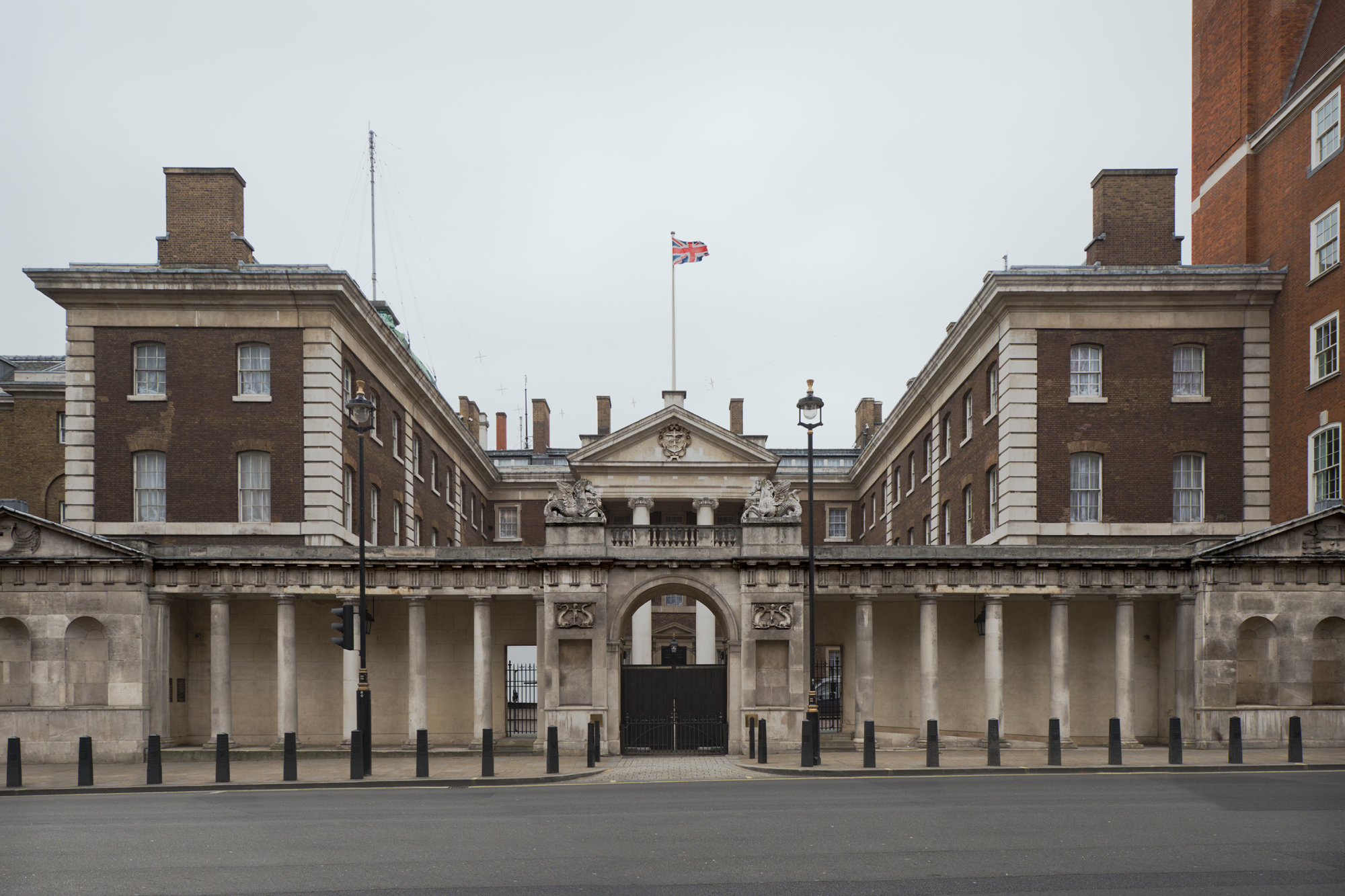
Charting Churchill: The Old Admiralty Building, Whitehall, London

Old Admiralty Building, Whitehall, London 2014 by Leslie Hossack

Old Admiralty Building, Whitehall, London 2014

Winston Churchill was appointed First Lord of the Admiralty on October 25th 1911. He was only 36 years old. This cabinet post brought added responsibilities, opportunities, challenges, influence and status. It also came with an official residence, Admiralty House, which was part of the massive Admiralty complex, seen above from Whitehall. In the spring of 1913, Winston and Clementine, along with their growing family, finally moved into Admiralty House where they lived until May 1915. Sarah Millicent Hermione, their third child, was born here on October 7th 1914, just two months after Great Britain declared war on Germany on August 14th 1914.

From 1911 to 1914, prior to the outbreak of World War I, Churchill worked hard to upgrade the Royal Navy and ready it for war. It was during this time that Winston developed his life-long love of aviation. He took flying lessons and earned the nicknamed The Flying First Lord. After some mishaps, he stopped flying himself, but he did establish the Royal Naval Air Service in preparation for war with Germany.

The image featured above is part of the limited edition collector’s portfolio created by Leslie Hossack to mark the 50th anniversary of the death of Sir Winston Churchill. She presents locations that chart Churchill’s personal and political life, from his birth at Blenheim Palace in 1874 until his death in London in 1965. THE CHURCHILL PHOTOGRAPHS are part of Hossack’s larger body of work that explores Nazi architecture in Berlin, Stalinist structures in Moscow, contested sites in Jerusalem, a Cold War bunker in Ottawa, NATO’s Headquarter Camp in Kosovo, and buildings linked to the Japanese Canadian internment during World War II.

To view more photographs, please visit Leslie’s website.  lesliehossack.com

Charting Churchill: 33 Eccleston Square, London

33 Eccleston Square, London 2014 by Leslie Hossack

33 Eccleston Square, London 2014

© Leslie Hossack

After their marriage in September 1908, Winston and Clementine Churchill settled into Winston’s townhouse at 12 Bolton Street. However, a few months later, in the spring of 1909, they moved to a larger home at 33 Eccleston Square, shown above. Here their first child, Diana, was born in 1909. In the period of 11 short months, Winston had gone from being a bachelor, to a married man, to a father. In 1911, Churchill’s only son, Randolph, was born at 33 Eccleston Square, where the family lived until 1913.

In addition to these changes in Winston’s personal life, the five years from 1908 to 1913 saw changes in his professional and political life. In 1910, Churchill published The People’s Rights. He also won two elections that year, on January 18th and on December 8th. During the period 1908 to 1913, Winston held three important cabinet posts: President of the Board of Trade from April 12th 1908 until February 18th 1910; Secretary of State for the Home Department from February 14th 1910 until October 25th 1911; and First Lord of the Admiralty commencing October 25th 1911. Churchill, only 36 years old, was ecstatic. This post brought added responsibilities, opportunities, challenges, influence and status. It also came with an official residence. However, Winston and Clementine and the children would remain at 33 Eccleston Square until the spring of 1913 when they finally moved into Admiralty House.

The image featured above is part of the limited edition collector’s portfolio created by Leslie Hossack to mark the 50th anniversary of the death of Sir Winston Churchill. She presents locations that chart Churchill’s personal and political life, from his birth at Blenheim Palace in 1874 until his death in London in 1965. THE CHURCHILL PHOTOGRAPHS are part of Hossack’s larger body of work that explores Nazi architecture in Berlin, Stalinist structures in Moscow, contested sites in Jerusalem, a Cold War bunker in Ottawa, NATO’s Headquarter Camp in Kosovo, and buildings linked to the Japanese Canadian internment during World War II.

To view more photographs, please visit Leslie’s website.  lesliehossack.com

Charting Churchill: The Defining Years, 1892-1908

Part 2, The Defining Years, 1892 – 1908

On November 30th, 2014, Sir Winston Churchill’s 140th birthday, Haute Vitrine started publishing images from the series THE CHURCHILL PHOTOGRAPHS by Leslie Hossack.

Yesterday’s post marked the end of Part 2, The Defining Years, 1892–1908. During these years, Sir Winston Churchill defined himself as an adventurer, lecturer, journalist, author, Member of Parliament, cabinet minister, and married man. Photographs featured in Part 2, The Defining Years can be reviewed below.

To view the photographs from Part 1, The Early Years, 1874-1892, please visit the Haute Vitrine posts of November 30th through December 9th, 2014.

Leslie Hossack’s CHARTING CHURCHILL will continue into January 2015, the month that marks the 50th anniversary of the death of Sir Winston Churchill.


Grand Entrance, Old College, Royal Military College, Sandhurst 2014 by Leslie HossackPortico, Old College, Royal Military College, Sandhurst 2014

Churchill Family Plot, Saint Martin's Churchyard, Bladon 2014 by Leslie HossackChurchill Family Plot, Saint Martin’s Churchyard, Bladon 2014

Stable Court, Blenheim Palace, Woodstock 2014 by Leslie HossackStable Court, Blenheim Palace, Woodstock 2014

Hatchard's Bookseller, 187 Piccadilly, London 2014 by Leslie HossackHatchard’s Bookseller, 187 Piccadilly, London 2014

James J. Fox Cigar Merchant, 19 St. James's Street, London 2014 by Leslie HossackJames J. Fox Cigar Merchant, 19 St. James’s Street, London 2014

105 Mount Street, London 2014 by Leslie Hossack105 Mount Street, London 2014

Big Ben and House of Commons, Houses of Parliament, London 2014 by Leslie HossackBig Ben and House of Commons, Houses of Parliament, London 2014

Temple of Diana, Blenheim Palace, Woodstock 2014 by Leslie HossackTemple of Diana, Blenheim Palace, Woodstock 2014

Saint Margaret's Church, Parliament Square, London 2014 by Leslie HossackSaint Margaret’s Church, Parliament Square, London 2014

12 Bolton Street, London 2014 by Leslie Hossack12 Bolton Street, London 2014

© Leslie Hossack

The images featured above are part of the limited edition collector’s portfolio created by Leslie Hossack to mark the 50th anniversary of the death of Sir Winston Churchill. She presents locations that chart Churchill’s personal and political life, from his birth at Blenheim Palace in 1874 until his death in London in 1965. To find out how these images are linked to Churchill, please see the previous posts here on Haute Vitrine.

THE CHURCHILL PHOTOGRAPHS are part of Hossack’s larger body of work that explores Nazi architecture in Berlin, Stalinist structures in Moscow, contested sites in Jerusalem, a Cold War bunker in Ottawa, NATO’s Headquarter Camp in Kosovo, and buildings linked to the Japanese Canadian internment during World War II.


To view more photographs, please visit Leslie’s website.  lesliehossack.com


Charting Churchill: 12 Bolton Street, London

12 Bolton Street, London 2014 by Leslie Hossack

12 Bolton Street, London 2014

© Leslie Hossack

After living in a bachelor flat at 105 Mount Street from 1900 to 1905, Winston Churchill moved into the red brick townhouse at 12 Bolton Street, shown above. This was his residence when he married Clementine on September 12th, 1908. After their honeymoon in Italy, the newly wed couple returned to London and set up their first married home at 12 Bolton Street, not far from Green Park and the Ritz Hotel.

So began a marriage that lasted until Sir Winston Churchill’s death, more than 56 years later. Winston Leonard Spencer Churchill and Clementine Ogilvy Hozier had five children: Diana (1909 – 1963), Randolph Frederick Edward (1911 – 1968), Sarah Millicent Hermione (1914 – 1982), Marigold Frances (1918 – 1921), and Mary (1922 – 2014). They also had ten grandchildren: Winston (Randolph & Pamela Digby); Arabella (Randolph & June Osborne); Julian, Edwina and Celia (Diana & Duncan Sandys); Nicholas, Emma, Charlotte, Jeremy and Rupert (Mary and Christopher Soames).

Winston and Clementine had a long, loving and fruitful marriage. As Churchill once said: “My most brilliant achievement was my ability to be able to persuade my wife to marry me.”

The image featured above is part of the limited edition collector’s portfolio created by Leslie Hossack to mark the 50th anniversary of the death of Sir Winston Churchill. She presents locations that chart Churchill’s personal and political life, from his birth at Blenheim Palace in 1874 until his death in London in 1965. THE CHURCHILL PHOTOGRAPHS are part of Hossack’s larger body of work that explores Nazi architecture in Berlin, Stalinist structures in Moscow, contested sites in Jerusalem, a Cold War bunker in Ottawa, NATO’s Headquarter Camp in Kosovo, and buildings linked to the Japanese Canadian internment during World War II.

To view more photographs, please visit Leslie’s website.  lesliehossack.com

Charting Churchill: Saint Margaret’s Church, Parliament Square, London

Saint Margaret's Church, Parliament Square, London 2014 by Leslie Hossack

Saint Margaret’s Church, Parliament Square, London 2014

© Leslie Hossack

On September 12th, 1908, Winston Leonard Spencer Churchill, age 33, married Clementine Ogilvy Hozier, age 23, in Saint Margaret’s Church, shown above. Saint Margaret’s, located right beside Westminster Abbey, is the Anglican parish church of the House of Commons. At the time of their marriage, Winston was a member of the Cabinet. The press had reported his engagement to Clementine a month earlier, and newspapers published a photograph of the newlyweds on their wedding day, en route to their reception at Lady St. Helier’s.

And so began a marriage that lasted 56 years, four months and 12 days. It is surely one of the most documented and examined relationships of all time, due to the volume of personal correspondence that survives. From the beginning, Winston and Clementine wrote letters to each constantly. Immediately after their engagement at Blenheim Palace, Clementine sent a note through the corridors to Winston. She signed off with the words: “Je t’aime passionément – I feel less shy in French. Clementine” It is difficult to know how many of the 20,589 days of their marriage the Churchills spent under the same roof; they were apart a great deal. However, they wrote to each other whether at home or away. Their notes often contained sketches of a pug dog and a pussy kat, referencing their pet names for each other.

Winston Churchill himself would later write, as the last line of his book My Early Life, “I married and lived happily ever afterwards.”

The image featured above is part of the limited edition collector’s portfolio created by Leslie Hossack to mark the 50th anniversary of the death of Sir Winston Churchill. She presents locations that chart Churchill’s personal and political life, from his birth at Blenheim Palace in 1874 until his death in London in 1965. THE CHURCHILL PHOTOGRAPHS are part of Hossack’s larger body of work that explores Nazi architecture in Berlin, Stalinist structures in Moscow, contested sites in Jerusalem, a Cold War bunker in Ottawa, NATO’s Headquarter Camp in Kosovo, and buildings linked to the Japanese Canadian internment during World War II.

To view more photographs, please visit Leslie’s website.  lesliehossack.com

Charting Churchill: Temple of Diana, Blenheim Palace

Temple of Diana, Blenheim Palace, Woodstock 2014 by Leslie Hossack

Temple of Diana, Blenheim Palace, Woodstock 2014

© Leslie Hossack

The years 1901 to 1908 were the foundation years of Winston Churchill’s adult life. These were extremely busy years; he worked hard and made many significant decisions in his professional, political and personal life. As he later reflected: “At Blenheim, I took two important decisions: to be born and to marry. I am happily content with the decisions I took on both occasions.” On August 11th, 1908, Winston proposed to Clementine Hozier in the Temple of Diana at Blenheim Palace, shown above.

That same month in 1908, Churchill was sworn into the Cabinet, as President of the Board of Trade. He had first taken his seat in the House of Commons in February 1901, and had launched his career as a parliamentarian with a maiden speech delivered from the seat his father had occupied when he resigned. Churchill left the Conservative Party in 1904 to join the Liberals, and he was appointed Under-Secretary of State for the Colonies in 1905. In 1906, he was elected Liberal M.P. for Manchester Northwest. He was subsequently defeated there in a 1908 by-election, but was elected M.P. for Dundee that same year.

Throughout all of these political changes and challenges, Winston was still busy writing. He published Mr. Brodrick’s Army (1903), Lord Randolph Churchill (1906), For Free Trade (1906) and My African Journey (1908). And last, but not least, he found time to fall in love with Clementine and win her hand in marriage. What characteristics of Winston eventually won her over? His “dominating charm and brilliancy” according to Churchill Trivia, The Churchill Centre.

The image featured above is part of the limited edition collector’s portfolio created by Leslie Hossack to mark the 50th anniversary of the death of Sir Winston Churchill. She presents locations that chart Churchill’s personal and political life, from his birth at Blenheim Palace in 1874 until his death in London in 1965. THE CHURCHILL PHOTOGRAPHS are part of Hossack’s larger body of work that explores Nazi architecture in Berlin, Stalinist structures in Moscow, contested sites in Jerusalem, a Cold War bunker in Ottawa, NATO’s Headquarter Camp in Kosovo, and buildings linked to the Japanese Canadian internment during World War II.

To view more photographs, please visit Leslie’s website.  lesliehossack.com

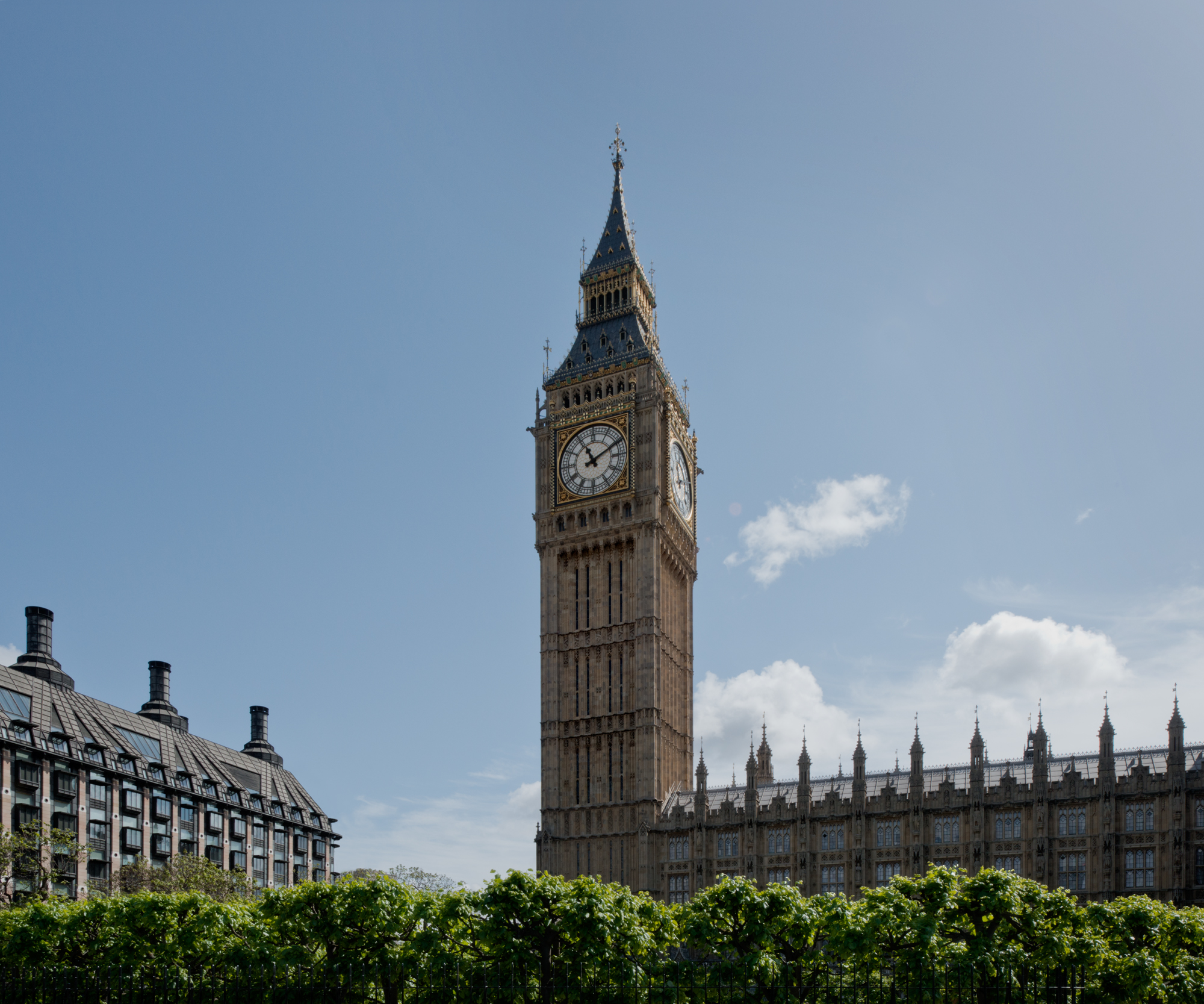
Charting Churchill: Big Ben and House of Commons, London

Big Ben, Elizabeth Tower, House of Commons, Houses of Parliament, London 2014 by Leslie Hossack

Big Ben and House of Commons, Houses of Parliament, London 2014

© Leslie Hossack

In October 1900, Winston Churchill was first elected to the House of Commons as the Conservative Member of Parliament for Oldham. This was the second of twenty-one elections that he contested. He lost in 1899, 1908, 1922, 1923 and 1924 but won the other sixteen elections. Thus Winston was a Member of Parliament for just over 62 years, spanning the time period 1900 – 1964. For further details, please visit The Churchill Centre.

Churchill had been preparing for this role for some time. In his book Churchill Style (2012), Barry Singer describes the self-tutoring program that Winston had embarked upon in India in 1896, when he asked his mother to send him a Parliamentary history of the last 100 years. “Once a set was supplied, the young scholar devised his own unique method for reading the twenty-seven volumes of the Annual Register of parliamentary debates. He did not read a debate until he had written down on paper his own opinion about its subject. After reading the debate, he reexamined his initial written view and then rewrote it.”

Winston’s father would have taken part in several debates recorded in the Annual Register. Lord Randolph Churchill was first elected to Parliament in 1874, the year he turned 25. Winston, who was born that same year, always looked up to his father. In 1900, it appeared Winston was following closely in his father’s footsteps when he was first elected to the House of Commons at the age of 25.

The image featured above is part of the limited edition collector’s portfolio created by Leslie Hossack to mark the 50th anniversary of the death of Sir Winston Churchill. She presents locations that chart Churchill’s personal and political life, from his birth at Blenheim Palace in 1874 until his death in London in 1965. THE CHURCHILL PHOTOGRAPHS are part of Hossack’s larger body of work that explores Nazi architecture in Berlin, Stalinist structures in Moscow, contested sites in Jerusalem, a Cold War bunker in Ottawa, NATO’s Headquarter Camp in Kosovo, and buildings linked to the Japanese Canadian internment during World War II.

To view more photographs, please visit Leslie’s website.  lesliehossack.com
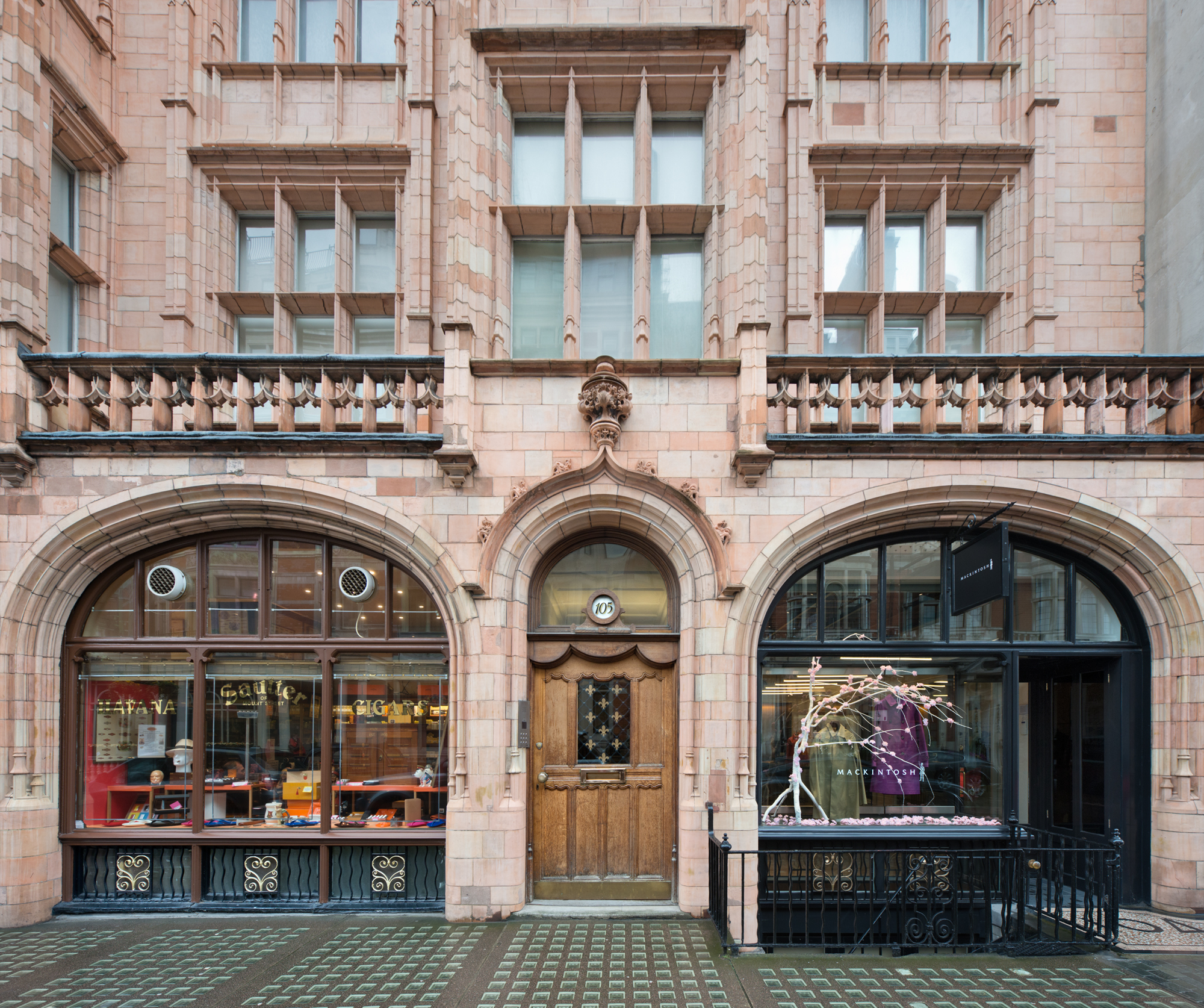
Charting Churchill: 105 Mount Street, London

105 Mount Street, London 2014 by Leslie Hossack

105 Mount Street, London 2014

© Leslie Hossack

The last year of the 19th Century saw Winston Churchill resign from the army and return to England. His first bid for a seat in Parliament was unsuccessful so he headed off to South Africa as a war correspondent. After being captured by the Boers, Winston escaped and made his way back to London. In August 1900, he moved into his first bachelor flat at 105 Mount Street, shown above. Two months later, he was elected to Parliament and began his life of public service.

As the 20th Century dawned, Winston Churchill, a child of Victorian England, was starting to settle down. However, he did not give up travel entirely. After his election in 1900, he sailed to the United States for a lecture tour that lasted through January 1901. The tour was hugely successful and helped to establish his international reputation as an outstanding orator. Winston had left England during the reign of Queen Victoria, and he returned to take up his duties as an elected Member of Parliament during the reign of Edward VII.

By now, Churchill was well known as an adventurer, lecturer, journalist and author. As of 1900, he had published countless newspaper articles and several books. These include: The Story of the Malakand Field Force (1898), The River War (1899), Savrola, his only novel (1900), London to Ladysmith via Pretoria (1900) and Ian Hamilton’s March (1900). To view a complete list of the 43 books written by Sir Winston Churchill, please visit The Churchill Centre.

The image featured above is part of the limited edition collector’s portfolio created by Leslie Hossack to mark the 50th anniversary of the death of Sir Winston Churchill. She presents locations that chart Churchill’s personal and political life, from his birth at Blenheim Palace in 1874 until his death in London in 1965. THE CHURCHILL PHOTOGRAPHS are part of Hossack’s larger body of work that explores Nazi architecture in Berlin, Stalinist structures in Moscow, contested sites in Jerusalem, a Cold War bunker in Ottawa, NATO’s Headquarter Camp in Kosovo, and buildings linked to the Japanese Canadian internment during World War II.

To view more photographs, please visit Leslie’s website.  lesliehossack.com