Dome of the Rock, Haram al-Sharif, Jerusalem

Access has been controlled and contested for thousands of years in the Old City.
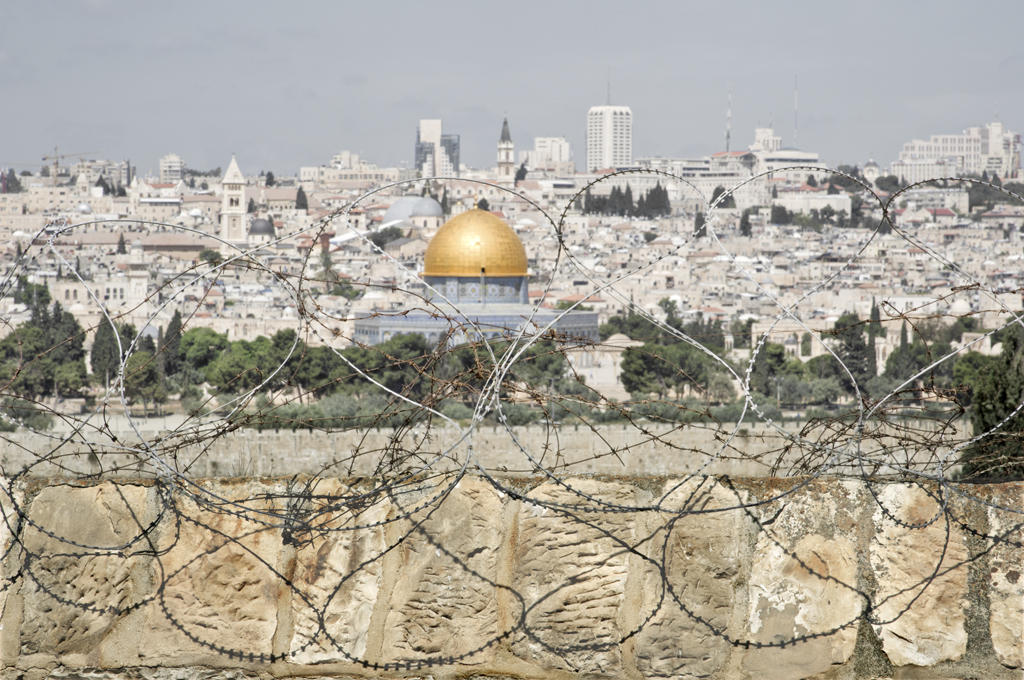
Dome of the Rock, Seen from the Mount of Olives, Jerusalem 2011

© Leslie Hossack

The world’s three great monotheistic religions have sacred sites in the Old City, and access has been controlled and contested for thousands of years. The Dome of the Rock, a Muslim Mosque built in 691 CE, sits atop the Foundation Stone on the Temple Mount. Seen here, the golden dome glows in the sunshine. In 1993, King Hussein of Jordan donated $8.2 million to fund 80 kilograms of gold to cover the dome.

On 29 November 1947, the United Nations passed a resolution calling for the establishment of a Jewish State. The State of Israel was declared on 14 May 1948, the day the British Mandate in Palestine ended. From 1948 to 1967, Jordan controlled East Jerusalem, and Israelis could not go to the Western Wall. During the 1967 Six-Day War, Israel occupied the Old City, but allowed the Muslim Religious Trust to manage “Haram al-Sharif” (the Temple Mount).

Since 1967, Jews have been able to visit the Western Wall. Today, anyone wishing to enter the Western Wall plaza must pass through strict airport style security. Visitors to Haram al-Sharif must pass through similar, but separate, security checks; however, men and women in immodest dress are not granted entrance. Non-Muslim visitors are not permitted to pray there or to enter the Dome of the Rock.

Life in Israel seems to revolve around issues of access and security in public spaces, both sacred and secular – from the Dome of the Rock and the Western Wall, to shopping malls and parking garages.
Gazing at the Dome of the Rock, Jerusalem

“Who is the owner of the language of this land? Who loves it more?

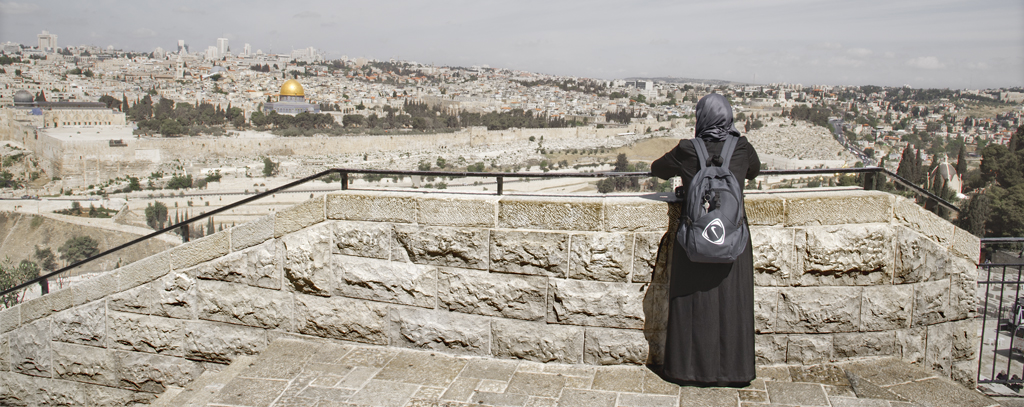
Woman Gazing at the Dome of the Rock, Jerusalem 2011

© Leslie Hossack

Located inside the Old City, the golden Dome of the Rock is situated within the walls of the Temple Mount, a holy place for Muslims and Jews. Covering an area of 35 acres, the Temple Mount remains under the control of Muslim religious authorities; however, responsibility for security was taken over by Israelis after their occupation of East Jerusalem in 1967.

In this photograph, the woman gazing at the Dome of the Rock is standing near the top of the Mount of Olives, looking out over the Jewish cemetery immediately beneath her. Across the valley, the Yusefiya Muslim Cemetery lies outside the walls of the Old City.

Muslims make up approximately 16% of the Israeli population while Jews make up 75% of the total population currently estimated at 7,746,000. Over 700,000 Palestinians are citizens of Israel, living inside the country’s 1949 armistice borders. About 1.2 million live in the West Bank (including 200,000 in East Jerusalem) and about one million in the Gaza Strip. (Middle East Research and Information Project) Israel is a place of complexities and inequities.

Mahmoud Darwish was widely regarded as the Palestinian national poet. He admired Hebrew poet Yehuda Amichai, but described his poetry as a “challenge to me, because we write about the same place. He wants to use the landscape and history for his own benefit, based on my destroyed identity. So we have a competition: who is the owner of the language of this land? Who loves it more? Who writes it better?”

Israeli Soldiers Outside the Walls of the Old City

“the protests created a symbolic yet very real ‘threat’ to the Israeli bubble”

Soldiers Outside the Walls of the Old City, Jerusalem 2011

© Leslie Hossack

These young soldiers are sitting outside the walls of the Old City, not far from the Jaffa Gate. Built in the 16th century, the city walls have eight gates, seven of which are still in use. Until the 1870s, the gates were closed everyday from sunset until sunrise. The soldiers here are members of the Israel Defense Forces (IDF). National military service is mandatory for all Israeli citizens over the age of 18; men serve for three years and women for two.

This photograph was taken just before the back-to-back celebrations of Memorial Day and Independence Day. May 14th, 1948 marks the day Israel became an independent state. However, Independence Day is celebrated in Israel according to the Hebrew calendar; therefore, it fell on May 10th in 2011, and will fall on April 26th in 2012.

Palestinians observe Al-Naqba Day (Day of Catastrophe) on May 15th, the day after Israeli Independence Day. During the war in 1948, over 700,000 Palestinians fled or were expelled from Palestine, and the vast majority of these refugees have been denied the right of return. On May 15th, 2011, thousands of flag-carrying, non-violent Palestinians gathered at Israel’s borders to protest the creation of the State of Israel and their expulsion from Palestine.

“This Nakba day, unlike previous Nakba days, constituted a regional, synchronized act of awakening… For the general Israeli public, the protests created a symbolic yet very real ‘threat’ to the Israeli bubble” (Mahdi Sabbagh, May 22nd, 2011, 972 Magazine)

from Paris to Berlin & Berlin to Jerusalem

Memorial to the Martyrs of the Deportation, Paris 2009

Memorial to the Murdered Jews of Europe, Berlin 2010

© Leslie Hossack

Having completed a major study of change and continuity in Paris in 2009, I travelled to Berlin in 2010 to continue my urban explorations. Somehow, Paris led to Berlin, and Berlin led to Jerusalem.

My journey to Israel in 2011 really started in Berlin. After completing a series of photographic studies of Nazi architecture and the Berlin Wall, I felt compelled to travel to Israel – another charged landscape. Put simply, I wanted to explore the link between historic Berlin and modern Israel. Berlin was my springboard to Israel, both literally and figuratively.

In both places, I was fascinated by the theme of loss, longing and lamentation – individual and collective. Loss of land, loss of innocence, loss of humanity, loss of freedom, loss of life: these notions haunted me in Berlin and in Israel. For me, the power of these iconic locations lies in the responses that they elicit from ordinary individuals.

After returning home from Israel, I was both intrigued and perplexed by what I had seen while observing everyday life in Jerusalem. I wanted to make some sense out of what I had witnessed. I do not pretend to understand the horrors of the Holocaust, the long and complex histories of the Holy City, or the current politics of the Israeli-Palestinian conflict.

However, the one question that kept running through my mind as I explored historic Berlin and modern Israel was: at what cost?