Two weeks ago, I posted Haute Vitrine’s first poll. Thank you for your feedback.

Cauldron, 1936 Olympic Stadium, Berlin 2010 was the favourite photograph.
YOU ARE NOW INVITED TO RESPOND TO A SECOND POLL. THANKS!
PHOTOGRAPHS by LESLIE HOSSACK
In 2005, Berlin dedicated this memorial to Jews who died in the Nazi Holocaust.

Memorial to the Murdered Jews of Europe, Berlin 2010
© Leslie Hossack
Today’s image is the last in a series of photographs from historic Berlin. Memorial to the Murdered Jews of Europe serves as the transition piece from Nazi Berlin to modern Israel in my exhibition CITIES OF STONE – PEOPLE OF DUST, on view at the Red Wall Gallery in Ottawa until September 2nd.
The Memorial to the Murdered Jews of Europe is located in the heart of Berlin near the Brandenburg Gate, where the Berlin Wall used to divide East and West Berlin. Design by American architect Peter Eisenman, this Holocaust memorial was inaugurated on May 10th, 2005, sixty years after the end of World War II.
The area covers four and a half acres, and consists of 2,711 blocks or stelae arranged in a grid. Narrow, undulating pathways run between the blank, concrete stelae which measure 7 feet 10 inches long, 3 feet 1 inch wide, and vary in height from 8 inches to 15 feet 9 inches. The site reminds one of an ancient graveyard, such as the Jewish cemetery on the Mount of Olives in Jerusalem. “I fought to keep names off the stones, because having names on them would turn it into a graveyard,” said Eisenman.”I like to think that people will use it for short cuts, as an everyday experience, not as a holy place.”
Beneath the memorial, an underground information centre holds the names of all known Jewish Holocaust victims; these names were obtained from the Israeli Holocaust History Museum at Yad Vashem in Jerusalem. Originally Eisenman objected to the inclusion of an information centre under the field of stelae, but later he said, “One is the unforgettable, which is the silence of the field; the other is the memorable, which is recorded in the archives.”
Over 70 years after Hitler and the Nazis came to power in 1933, Berlin dedicated this memorial to the more than six million Jews who died in the Holocaust, the murdered Jews of Europe.
Architect: Peter Eisenman Date: 2004
BERLIN STUDIEN selected as finalist in Photography Book Now 2011 International Juried Competition

BERLIN STUDIEN was selected for People’s Choice voting and will go on to the final round of the Photography Book Now 2011 competition judging. This year, more than 2,000 books were submitted.
To vote for your favorite book by August 30, please visit:
http://photographybooknow.blurb.com/peoples-choice/category/documentary
BERLIN STUDIEN, photographic studies of historic Berlin today, includes my photographs from Berlin which I have been posting on Haute Vitrine for the past few weeks. It also includes the images of my Studio 255 colleagues Barbara Bolton, Abigail Gossage and Patricia Wallace. Working with these three fabulous women, along with our coach Michael Tardioli, as I designed and edited this book was, as always, an absolute pleasure!
BERLIN STUDIEN, a photographic study of historic Berlin today, is a collection of sumptuous images exploring one of the world’s most infamous cities – Berlin, a city with a past. Berlin reveals its history as raw scars clearly visible at every turn. Like the city itself, this volume both delights and disturbs.
How do you commemorate Berlin’s past without memorializing madness and trivializing victims? Berliners, and anyone attempting to photograph their city, must try to come to terms with acknowledging the past, while at the same time not exploiting it. This challenge was taken up by four Canadian photographers: Barbara Bolton, Abigail Gossage, Leslie Hossack and Patricia Wallace. In 2010 they travelled to Berlin where they explored Nazi architecture, Holocaust history, Stasi relics, and the quieter side of life in the city today.
The result is a collection of photographs that are sensuous and seductive, stark and spectacular, understated and engaging. BERLIN STUDIEN acknowledges the city’s tragic past, while at the same time celebrating its current status as a vibrant world capital. This is an anthology of revealing images that are in turn dramatic, disturbing, gentle, monumental. They explore the diabolical and the humble, the past and the present, the famous and the forgotten. Above all, these are truthful images. They provide an honest examination of Berlin today, after centuries of conflict and recent reunification.
Each photograph in BERLIN STUDIEN is accompanied by a descriptive text created by the artist. This volume also features a foreword by Michael Tardioli and an essay by Michael Schreier.
© Leslie Hossack
In 1937 Hitler commandeered the Berlin Academy for his architect Albert Speer.

Ihne Tower Staircase, Academy of Arts, Berlin 2010
© Leslie Hossack
The Academy of Arts building created by Ernst von Ihne in 1906 is linked to National Socialist architecture more by anecdote than by design. In 1937, Hitler commandeered the Academy for his architect, Albert Speer, whom he had named Inspector General of Buildings for the Renovation of the Federal Capital. It was here on Pariser Platz, in the skylight rooms of the old Academy building, that Speer built his 30-foot model of Germania.
Hitler often visited to inspect the model and to discuss his monumental plans for the rebuilding of Berlin. Speer put forth his “Theory of Ruin Value” which proposed building structures in such a way that they would resemble Roman models, even in a state of decay after 1000 years. Hitler subsequently ordered that all the important buildings of his Reich must be constructed according to this law of ruins.
During WW II, the Academy building was badly damaged and later it was completely demolished, except for the Ihne Tower staircase shown in this photograph and the original skylight rooms. Located near the Brandenburg Gate, these remains formed part of the death strip along the Berlin Wall from 1961 to 1989. At one time, the East German government built a detention cell in the structure to imprison people who had been caught too close to the border.
After German reunification, the new Academy of Arts complex eventually opened in 2005. It is a stunning concrete and glass structure built around the historic remnants of the original skylight rooms and staircase.
Architect: Ernst von Ihne Date: 1904-1906
Architects: Behnisch & Partner with Werner Durth Date: 1994-2005
In 1938 Hitler had Albert Speer move Berlin’s Victory Column to Grosser Stern.

Victory Column, Grosser Stern, Berlin 2010
© Leslie Hossack
The Victory Column was originally located in front of the Reichstag, the home of the German Parliament. In 1938, in line with Hitler’s plans to redesign Berlin as a world capital called Germania, he had his architect Albert Speer move the Victory Column to Grosser Stern (Great Star). At the same time, Hitler added a fourth section to the column, making it almost 67 metres high. It is topped by a sculpture of Victoria, nicknamed Goldelse by Berliners.
Speer redesigned Grosser Stern, a huge traffic circle situated in the centre of the Tiergarten, and widened the east-west axis road running between it and the Brandenburg Gate. He also designed four classical pavilions around the circle; these provide access to pedestrian tunnels running under the roadway to the Victory Column in the centre of the Great Star. These pavilions and tunnels still exist today.
To the east and west of the Victory Column, more than 700 light standards designed by Speer were installed along the ceremonial avenue now called Strasse des 17. Juni. Near the end of WW II, the lampposts between the Brandenburg Gate and the western end of the Tiergarten were removed in order to use the road as a runway for German planes. Thus only about half of the original light standards remain in place today.
As can be seen in this photograph, the Victory Column is once again undergoing renovations. This iconic landmark is a remarkable example of urban change and continuity in the historic city of Berlin.
Original Architect: Heinrich Strack Date: 1873
Relocation Architect: Albert Speer Date: 1938-1939
Tempelhof Berlin used to be one of the world’s largest and busiest airports.
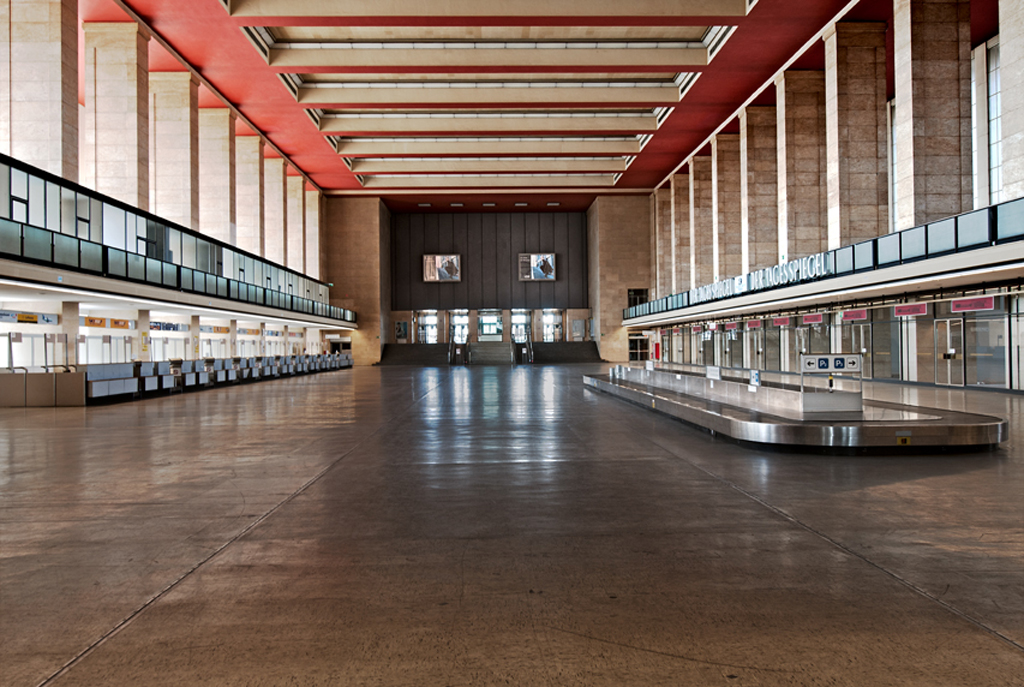
Central Hall, Tempelhof Airport, Berlin 2010
© Leslie Hossack
Tempelhof Airport is a registered historic monument. The site was originally Knights Templar land in medieval Berlin, and this is the origin of the name Tempelhof. In 1909, Armand Zipfel made the first flight demonstration at Tempelhof, followed by Orville Wright that same year.
In 1923, Tempelhof was officially designated an airport. As part of Albert Speer’s plan for the reconstruction of Berlin, Ernst Sagebiel was ordered to replace the old terminal with a new building in 1934. Designed in monumental Nazi style, Sagebiel’s main entrance doors open into a four-story high Hall of Honour. From there, stairs lead down into the central hall shown in this photograph. Here the walls are divided by rectangular columns and high windows, and from galleries suspended on either side, visitors watched passenger operations.
At one time Tempelhof was the central airport for the city and the largest building in Berlin. During WW II, several basement rooms under the administrative building were finished as air-raid shelters for Lufthansa and airport employees, and for people from the neighborhood. Damaged during the war, the airport complex underwent additional changes from 1959 to 1962.
After the fall of the Berlin Wall and German reunification, the Allied occupation of Berlin came to an end. In July 1994, the British, French and American forces were deactivated in a ceremony on the Four Ring Parade Field at Tempelhof, and the Western Allies returned the city of Berlin to the German government.
Architect: Ernst Sagebiel Date: 1935-1941
Tempelhof Berlin was built in classic Nazi “monumental”style.

Canopy Roof and Tarmac, Tempelhof Airport, Berlin 2010
© Leslie Hossack
Nazi government buildings such as Tempelhof Airport were generally built in a monumental style designed to intimidate the individual and exalt the state. Sometimes, two different styles were used in the same structure. The street side of Tempelhof has an imposing classic appearance, while the airfield side, with its steel gate construction, looks modern and almost transparent.
Inside the airport, the huge departure hall is 1.2 km long. Outside, the flight gates are covered by a canopy-style roof to protect passengers from the elements. These flight gates and the projecting steel roof form an enormous semicircular apron that was designed to resemble an eagle in flight with outspread wings. The roof of the main airport hall was built to support bleachers to allow up to 65,000 spectators to watch flight demonstrations, but the stands were never completed.
The plane in this photograph is the last one at Tempelhof. It sits alone on the tarmac in stark contrast to the time when the airport was the busiest in the world. Tempelhof was the site of the 1948-49 Berlin Airlift when the Soviet authorities closed off Berlin. The Western Powers sustained the city by providing essential supplies by air, landing at the rate of one plane every three minutes. Later, during the Cold War, Tempelhof was the main terminal for American planes accessing Berlin.
Tempelhof Airport was officially closed on October 30th, 2008, and it is still awaiting news of its fate. In May 2010, the outfield at Tempelhof was opened as Berlin’s largest public park and named “Tempelhofer Feld.”
Architect: Ernst Sagebiel Date: 1935-1941
Tempelhof Berlin was once described as “the mother of all airports.”
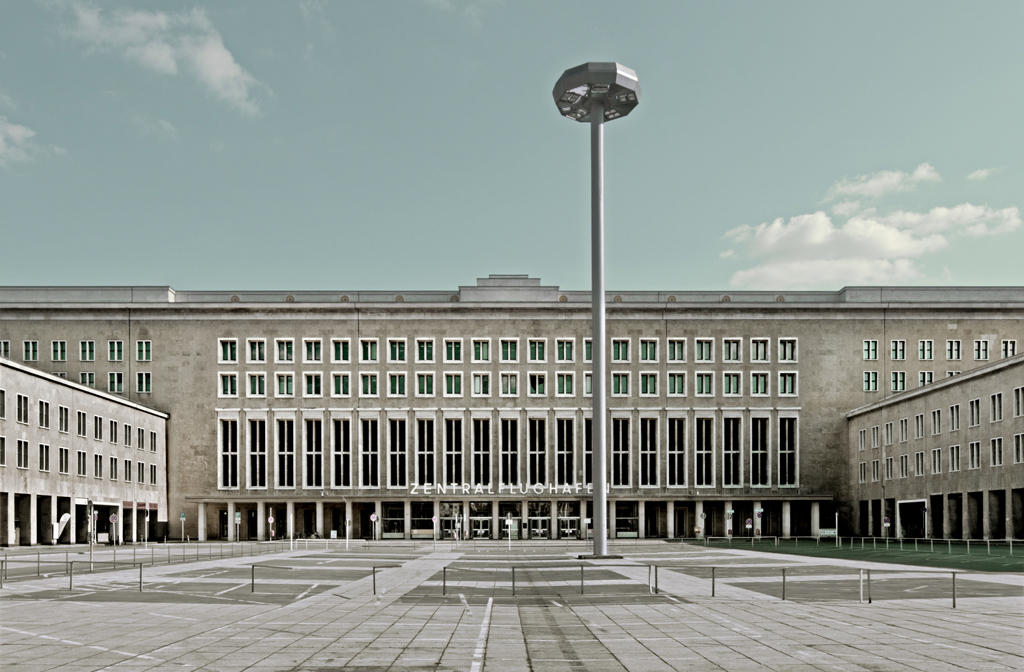
Entrance Plaza, Tempelhof Airport, Berlin 2010
© Leslie Hossack
Tempelhof Airport was described by the renowned British architect Sir Norman Foster as “the mother of all airports.”
Built by the Nazis, Tempelhof was taken by the Soviets during the Battle of Berlin at the end of WW II. Shortly thereafter, the airport was turned over to the United States as part of the American occupation of Berlin.
In 1937, Hitler had appointed his favourite architect, Albert Speer, to the position of “General Building Inspector for the Redesign of the Reich Capital.” Tempelhof was built in line with Speer’s grandiose plans to expand Berlin into a global capital called Germania.
Nazi administration buildings such as Tempelhof Airport were built in a monumental style that reduced design to its essentials. This approach is distinguished by smooth unadorned surfaces that appear severe and two-dimensional. The National Socialist style is often characterized by a reinforced concrete frame that is clad in natural stone; façades are flat and symmetrical, and window frames are rectangular with sharp edges.
Tempelhof Airport is a typical example, with its identical rows of windows. The large entrance plaza seen in this photograph is framed by three-story wing structures on either side of the massive five-story reception building with its 21 entrance doors. A 45-metre-high Reich eagle sat on the roof of the main building until 1962; today, only its head is left on display in front of the plaza.
Architect: Ernst Sagebiel Date: 1935-1941
For almost thirty years the Berlin Wall divided a city and defined a generation.

The Wall, Niederkirchner Strasse, Berlin 2010
© Leslie Hossack
At 2 a.m. on August 13th, 1961, East German soldiers began building the wall with barbed wire. Soon, West Berlin was enclosed by a fortified frontier 160 km long. Officially known as the Anti-fascist Protective Rampart, the wall was really put up to prevent East Germans from fleeing to the West. Eventually, the barbed wire was replaced with a concrete wall 3.6 metres high. There were up to 14 border crossings, including Checkpoint Charlie and the Brandenburg Gate.
For almost thirty years the Berlin Wall divided a city and defined a generation around the world. This photograph surveys one of the last remnants of the wall, an iconic relic of the Cold War protected for posterity behind a fence. It was badly damaged in 1989/90 by “wall-peckers” who attacked the wall with hammers during the nights after the opening of the frontier November 9th, 1989.
In Berlin today, little evidence of the wall remains. This section of the wall on Niederkirchner Strasse runs past the former site of the Nazi Security Headquarters created in 1939; this was also the headquarters of the SS. Unseen behind the viewer, still stands Göring’s gigantic Reich Aviation Ministry which was designed by Ernst Sagebiel and built in 1935-1936.

My photograph entitled The Wall, Niederkirchner Strasse is a construction, not a stitch. It measures eight feet long and is currently on view in my exhibition CITIES OF STONE – PEOPLE OF DUST at the Red Wall Gallery in Ottawa until September 2nd. This photograph is intended to simulate a walk along the Berlin Wall today, 50 years after it first appeared. I posted this image at 2 a.m. to coincide with the time that the Berlin Wall was born on August 13th, 1961.
There are many people in the world who really don’t understand, or say they don’t, what is the great issue between the free world and the Communist world. Let them come to Berlin. … All free men, wherever they may live, are citizens of Berlin. And, therefore, as a free man, I take pride in the words “Ich bin ein Berliner.” – President John F. Kennedy, in a speech in West Berlin, 26 June 1963
Berlin is the testicle of the West. When I want the West to scream, I squeeze on Berlin.
– Premier Nikita Krushchev, in a speech in Yugoslavia, 24 August 1963

Berlin Wall Detail # 9, from The Wall, Niederkirchner Strasse, Berlin 2010
The two image details shown here are taken from my photograph entitled The Wall, Niederkirchner Strasse. The original photograph is a construction, not a stitch. It measures eight feet long and is currently on view in my exhibition CITIES OF STONE – PEOPLE OF DUST at the Red Wall Gallery in Ottawa until September 2nd.
This photograph is intended to simulate a walk along the Berlin Wall today, 50 years after it first appeared. Tomorrow I will post the entire image at 2 a.m. to coincide with the time that the Berlin Wall was born on August 13th, 1961.

Berlin Wall Detail # 10, from The Wall, Niederkirchner Strasse, Berlin 2010
© Leslie Hossack
 HAUTE VITRINE