Remembrance Day, 11/11/11

Unconditional Surrender, Karlshorst, Berlin 2010

© Leslie Hossack

World War I officially ended at the 11th hour of the 11th day of the 11th month of 1918, with the signing of the Armistice. Remembrance Day is still observed at that time, and this year’s ceremonies will take place today, at the 11th hour of the 11th day of the 11th month of 2011.

World War I, The War to End All Wars, was fought from 1914 to 1918. Just over 20 years later in 1939, World War II broke out and lasted almost seven years. Nazi Germany, and the war in Europe, finally came to an end with the signing of an unconditional surrender on May 8th 1945.

This historic event took place in the room shown above. It is located in the Karlshorst district of Berlin, in a building constructed in 1936-1938 by Germany’s National Socialist government. The building initially served as the officers’ mess of the German Armed Forces Pioneer School. After World War II,  it was the seat of the Soviet Military Administration in Germany from 1945-1949. Today it is the German-Russian Museum. www.museum-karlshorst.de

the 11th hour of the 11th day of the 11th month

Karlshorst, Berlin 2010

© Leslie Hossack

World War I officially ended at the 11th hour of the 11th day of the 11th month of 1918, with the signing of the Armistice. Remembrance Day is still observed at that time, and this year’s ceremonies will take place tomorrow at the 11th hour, on 11/11/11.

World War I, The War to End All Wars, was fought from 1914 to 1918. Just over 20 years later in 1939, World War II broke out and lasted almost seven years. Nazi Germany, and the war in Europe, finally came to an end with the signing of an unconditional surrender on May 8th 1945.

This historic event took place in the building shown above, which is located in the Karlshorst district of Berlin. It was built in 1936-1938, and served as the officers’ mess of the German Armed Forces Pioneer School. After WW II,  it was the seat of the Soviet Military Administration in Germany from 1945-1949. Today it is the German-Russian Museum.

This photograph was taken in 2010, 65 years after the signing of the instrument of surrender took place in the large ground floor room at the back of the building.

Shortly before midnight on May 8, a second unconditional surrender was signed in the outskirts of Berlin, Germany. The signing ceremony took place in a villa in an eastern suburb of Berlin called Karlshorst. Representatives of the USSR, Great Britain, France, and the United States arrived shortly before midnight. After Soviet Field Marshal Georgy Zhukov opened the ceremony, the German command representatives headed by General Field Marshal Wilhelm Keitel were invited into the room, where they signed the final German Act of Unconditional Surrender entering into force at 23:01 Central European Time.  www.veday.info

Part 4: Israeli Separation Wall, Jerusalem

My name is Ozymandias, king of kings: Look on my works, ye Mighty, and despair!


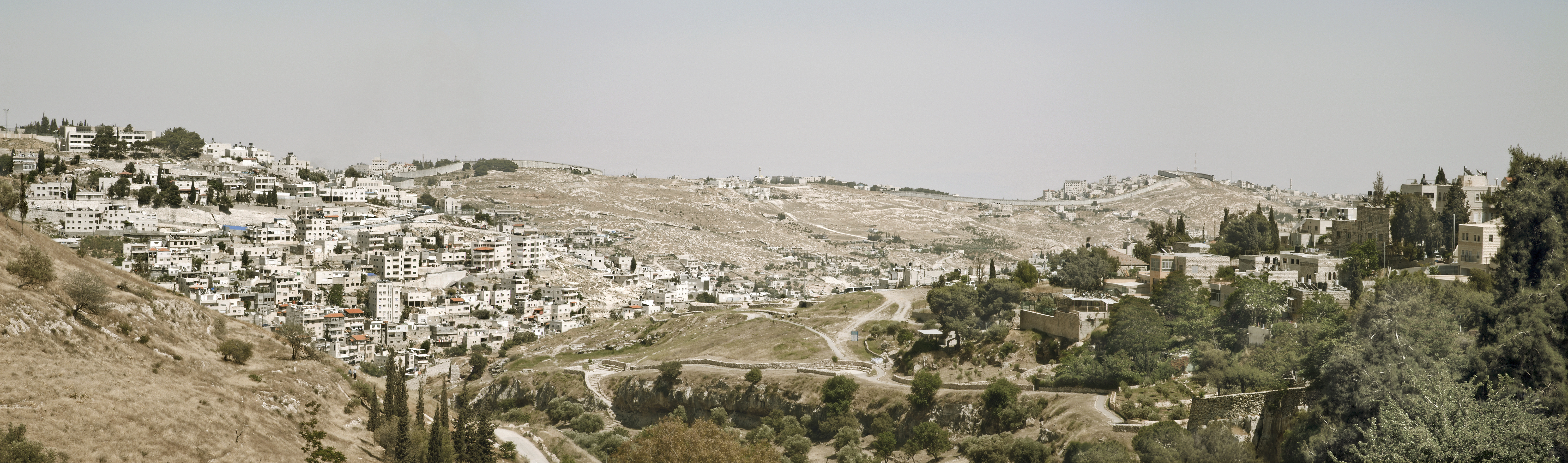
The Separation Wall, Seen from Bloomfield Gardens, Jerusalem 2011

© Leslie Hossack

Three iconic cities, Berlin, Jerusalem and Masada, have recently been featured on Haute Vitrine. These “cities of stone” are also cities of walls: the Berlin Wall, the fortress walls at Masada, and the Jerusalem Envelope seen here.

City of Stone, The Hidden History of Jerusalem reveals more than just a holy city built of stone. Meron Benvenisti describes Jerusalem as the domain of Muslims, Jews, and Christians, locked in a perpetual contest where shrines, housing projects, and bulldozers compete in a scramble for possession.

All cities tell a story; cities of stone tell an eternal story. “Architecture matters because it lasts,” writes Deyan Sudjic. “It is a means of setting the historical record straight… To imagine Hitler completing the construction of the triumphalist city of stone that he planned with Albert Speer is to imagine his total victory.” (Engineering Conflict, New York Times, 21 May 2006)

Structures of stone have endured for millennia, but the people who build them are gone in the blink of an eye. “Ashes to ashes, dust to dust.” Israel’s first Prime Minister, David Ben-Gurion, called Holocaust survivors human dust. “Turning these people of dust into a cultured, independent nation with a vision will be no easy task.” (The Lemon Tree, Sandy Tolan)

“My name is Ozymandias, king of kings: / Look on my works, ye Mighty, and despair!” Nothing beside remains. Round the decay / Of that colossal wreck, boundless and bare The lone and level sands stretch far away.

excerpt from Ozymandias by Percy Shelly

from Paris to Berlin & Berlin to Jerusalem

Memorial to the Martyrs of the Deportation, Paris 2009

Memorial to the Murdered Jews of Europe, Berlin 2010

© Leslie Hossack

Having completed a major study of change and continuity in Paris in 2009, I travelled to Berlin in 2010 to continue my urban explorations. Somehow, Paris led to Berlin, and Berlin led to Jerusalem.

My journey to Israel in 2011 really started in Berlin. After completing a series of photographic studies of Nazi architecture and the Berlin Wall, I felt compelled to travel to Israel – another charged landscape. Put simply, I wanted to explore the link between historic Berlin and modern Israel. Berlin was my springboard to Israel, both literally and figuratively.

In both places, I was fascinated by the theme of loss, longing and lamentation – individual and collective. Loss of land, loss of innocence, loss of humanity, loss of freedom, loss of life: these notions haunted me in Berlin and in Israel. For me, the power of these iconic locations lies in the responses that they elicit from ordinary individuals.

After returning home from Israel, I was both intrigued and perplexed by what I had seen while observing everyday life in Jerusalem. I wanted to make some sense out of what I had witnessed. I do not pretend to understand the horrors of the Holocaust, the long and complex histories of the Holy City, or the current politics of the Israeli-Palestinian conflict.

However, the one question that kept running through my mind as I explored historic Berlin and modern Israel was: at what cost?

Memorial to the Murdered Jews of Europe

In 2005, Berlin dedicated this memorial to Jews who died in the Nazi Holocaust.

Memorial to the Murdered Jews of Europe, Berlin 2010

© Leslie Hossack

Today’s image is the last in a series of photographs from historic Berlin. Memorial to the Murdered Jews of Europe serves as the transition piece from Nazi Berlin to modern Israel in my exhibition CITIES OF STONE – PEOPLE OF DUST, on view at the Red Wall Gallery in Ottawa until September 2nd.

The Memorial to the Murdered Jews of Europe is located in the heart of Berlin near the Brandenburg Gate, where the Berlin Wall used to divide East and West Berlin. Design by American architect Peter Eisenman, this Holocaust memorial was inaugurated on May 10th, 2005, sixty years after the end of World War II.

The area covers four and a half acres, and consists of 2,711 blocks or stelae arranged in a grid. Narrow, undulating pathways run between the blank, concrete stelae which measure 7 feet 10 inches long, 3 feet 1 inch wide, and vary in height from 8 inches to 15 feet 9 inches. The site reminds one of an ancient graveyard, such as the Jewish cemetery on the Mount of Olives in Jerusalem. “I fought to keep names off the stones, because having names on them would turn it into a graveyard,” said Eisenman.”I like to think that people will use it for short cuts, as an everyday experience, not as a holy place.”

Beneath the memorial, an underground information centre holds the names of all known Jewish Holocaust victims; these names were obtained from the Israeli Holocaust History Museum at Yad Vashem in Jerusalem. Originally Eisenman objected to the inclusion of an information centre under the field of stelae, but later he said, “One is the unforgettable, which is the silence of the field; the other is the memorable, which is recorded in the archives.”

Over 70 years after Hitler and the Nazis came to power in 1933, Berlin dedicated this memorial to the more than six million Jews who died in the Holocaust, the murdered Jews of Europe.

Architect: Peter Eisenman  Date: 2004

Ihne Tower Staircase, Academy of Arts

In 1937 Hitler commandeered the Berlin Academy for his architect Albert Speer.

Ihne Tower Staircase, Academy of Arts, Berlin 2010

© Leslie Hossack

The Academy of Arts building created by Ernst von Ihne in 1906 is linked to National Socialist architecture more by anecdote than by design. In 1937, Hitler commandeered the Academy for his architect, Albert Speer, whom he had named Inspector General of Buildings for the Renovation of the Federal Capital. It was here on Pariser Platz, in the skylight rooms of the old Academy building, that Speer built his 30-foot model of Germania.

Hitler often visited to inspect the model and to discuss his monumental plans for the rebuilding of Berlin. Speer put forth his “Theory of Ruin Value” which proposed building structures in such a way that they would resemble Roman models, even in a state of decay after 1000 years. Hitler subsequently ordered that all the important buildings of his Reich must be constructed according to this law of ruins.

During WW II, the Academy building was badly damaged and later it was completely demolished, except for the Ihne Tower staircase shown in this photograph and the original skylight rooms. Located near the Brandenburg Gate, these remains formed part of the death strip along the Berlin Wall from 1961 to 1989. At one time, the East German government built a detention cell in the structure to imprison people who had been caught too close to the border.

After German reunification, the new Academy of Arts complex eventually opened in 2005. It is a stunning concrete and glass structure built around the historic remnants of the original skylight rooms and staircase.

Architect:  Ernst von Ihne                                                              Date: 1904-1906

Architects:  Behnisch & Partner with Werner Durth                 Date: 1994-2005

Victory Column, Grosser Stern

In 1938 Hitler had Albert Speer move Berlin’s Victory Column to Grosser Stern.

Victory Column, Grosser Stern, Berlin 2010

© Leslie Hossack

The Victory Column was originally located in front of the Reichstag, the home of the German Parliament. In 1938, in line with Hitler’s plans to redesign Berlin as a world capital called Germania, he had his architect Albert Speer move the Victory Column to Grosser Stern (Great Star). At the same time, Hitler added a fourth section to the column, making it almost 67 metres high. It is topped by a sculpture of Victoria, nicknamed Goldelse by Berliners.

Speer redesigned Grosser Stern, a huge traffic circle situated in the centre of the Tiergarten, and widened the east-west axis road running between it and the Brandenburg Gate. He also designed four classical pavilions around the circle; these provide access to pedestrian tunnels running under the roadway to the Victory Column in the centre of the Great Star. These pavilions and tunnels still exist today.

To the east and west of the Victory Column, more than 700 light standards designed by Speer were installed along the ceremonial avenue now called Strasse des 17. Juni. Near the end of WW II, the lampposts between the Brandenburg Gate and the western end of the Tiergarten were removed in order to use the road as a runway for German planes. Thus only about half of the original light standards remain in place today.

As can be seen in this photograph, the Victory Column is once again undergoing renovations. This iconic landmark is a remarkable example of urban change and continuity in the historic city of Berlin.

Original Architect:  Heinrich Strack                                    Date: 1873

Relocation Architect:  Albert Speer                                      Date: 1938-1939

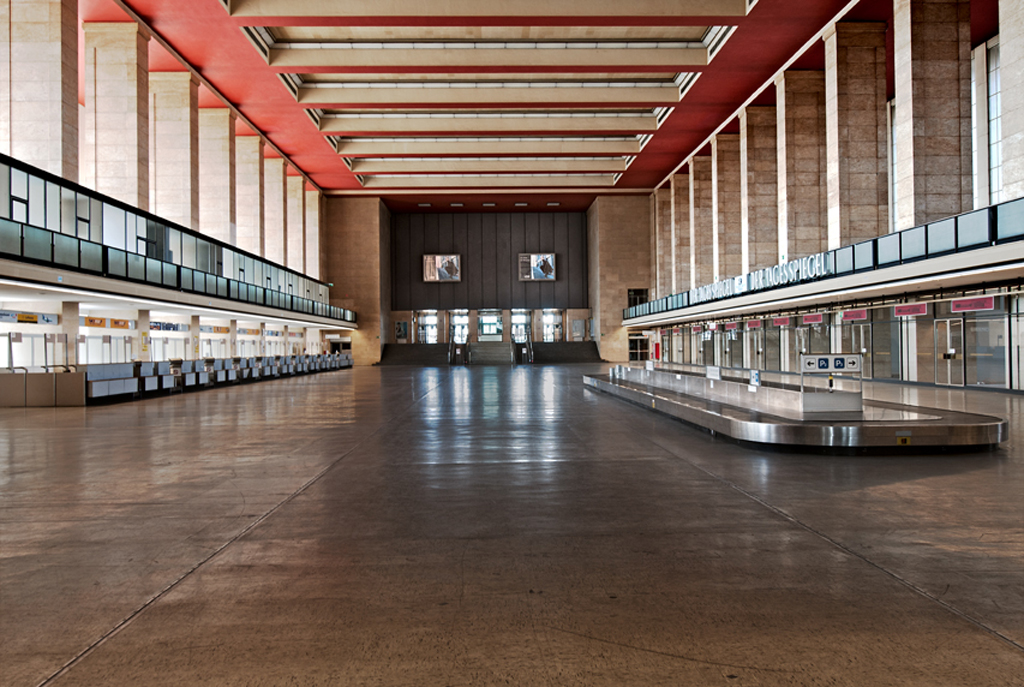
Central Hall, Tempelhof Airport

Tempelhof Berlin used to be one of the world’s largest and busiest airports.

Central Hall, Tempelhof Airport, Berlin 2010

© Leslie Hossack

Tempelhof Airport is a registered historic monument. The site was originally Knights Templar land in medieval Berlin, and this is the origin of the name Tempelhof. In 1909, Armand Zipfel made the first flight demonstration at Tempelhof, followed by Orville Wright that same year.

In 1923, Tempelhof was officially designated an airport. As part of Albert Speer’s plan for the reconstruction of Berlin, Ernst Sagebiel was ordered to replace the old terminal with a new building in 1934. Designed in monumental Nazi style, Sagebiel’s main entrance doors open into a four-story high Hall of Honour. From there, stairs lead down into the central hall shown in this photograph. Here the walls are divided by rectangular columns and high windows, and from galleries suspended on either side, visitors watched passenger operations.

At one time Tempelhof was the central airport for the city and the largest building in Berlin. During WW II, several basement rooms under the administrative building were finished as air-raid shelters for Lufthansa and airport employees, and for people from the neighborhood. Damaged during the war, the airport complex underwent additional changes from 1959 to 1962.

After the fall of the Berlin Wall and German reunification, the Allied occupation of Berlin came to an end. In July 1994, the British, French and American forces were deactivated in a ceremony on the Four Ring Parade Field at Tempelhof, and the Western Allies returned the city of Berlin to the German government.

Architect: Ernst Sagebiel          Date: 1935-1941

Canopy Roof and Tarmac, Tempelhof Airport

Tempelhof Berlin was built in classic Nazi “monumental”style.

Canopy Roof and Tarmac, Tempelhof Airport, Berlin 2010

© Leslie Hossack

Nazi government buildings such as Tempelhof Airport were generally built in a monumental style designed to intimidate the individual and exalt the state. Sometimes, two different styles were used in the same structure. The street side of Tempelhof has an imposing classic appearance, while the airfield side, with its steel gate construction, looks modern and almost transparent.

Inside the airport, the huge departure hall is 1.2 km long. Outside, the flight gates are covered by a canopy-style roof to protect passengers from the elements. These flight gates and the projecting steel roof form an enormous semicircular apron that was designed to resemble an eagle in flight with outspread wings. The roof of the main airport hall was built to support bleachers to allow up to 65,000 spectators to watch flight demonstrations, but the stands were never completed.

The plane in this photograph is the last one at Tempelhof. It sits alone on the tarmac in stark contrast to the time when the airport was the busiest in the world. Tempelhof was the site of the 1948-49 Berlin Airlift when the Soviet authorities closed off Berlin. The Western Powers sustained the city by providing essential supplies by air, landing at the rate of one plane every three minutes. Later, during the Cold War, Tempelhof was the main terminal for American planes accessing Berlin.

Tempelhof Airport was officially closed on October 30th, 2008, and it is still awaiting news of its fate. In May 2010, the outfield at Tempelhof was opened as Berlin’s largest public park and named “Tempelhofer Feld.”

Architect: Ernst Sagebiel          Date: 1935-1941