Al-Aqsa Mosque Complex, Jerusalem

“Write down! I am an Arab…”
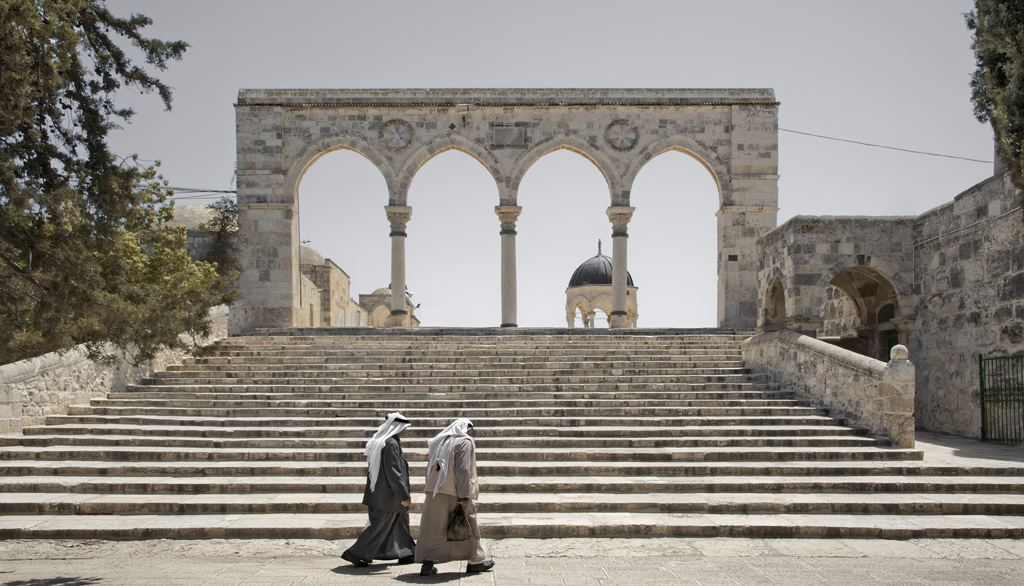
Al-Aqsa Mosque Complex, Haram al-Sharif, Jerusalem 2011

© Leslie Hossack

In the Islamic and Jewish religions, Haram al-Sharif (Temple Mount) is believed to be the area on Mount Moriah where Abraham went to sacrifice his son. Muslims identify this site as the furthermost sanctuary; from here Mohammed, accompanied by the angel Gabriel, made his night journey to the throne of God. The Al-Aqsa Mosque complex is the third holiest site, after Mecca and Medina.

The men in this photograph are walking along the western side of Haram al-Sharif, above the Western Wall. Each man is wearing a keffiyeh, the traditional Arab headdress made from a square of white cotton and held in place by a rope. The keffiyeh became a symbol of Palestinian nationalism during the Arab Revolt in the 1930s. In the 1960s, it became associated with the Palestinian resistance movement; Yasser Arafat was rarely seen without his black-and-white keffiyeh.

Celebrated Palestinian poet Mahmoud Darwish was a member of Arafat’s Palestine Liberation Organization. Darwish became famous with his poem Identity Card. Occupied Palestine is divided into three sections, and residents need identity cards: blue cards for Palestinians living in Jerusalem, and green cards for Palestinians in the Gaza Strip and the West Bank.

Write down!
I am an Arab
Employed with fellow workers at a quarry
I have eight children
I get them bread
Garments and books
from the rocks …

Write down!
I am an Arab
You have stolen the orchards of my ancestors
And the land which I cultivated
Along with my children
And you left nothing for us
Except for these rocks …

excerpt from Identity Card by Mahmoud Darwish
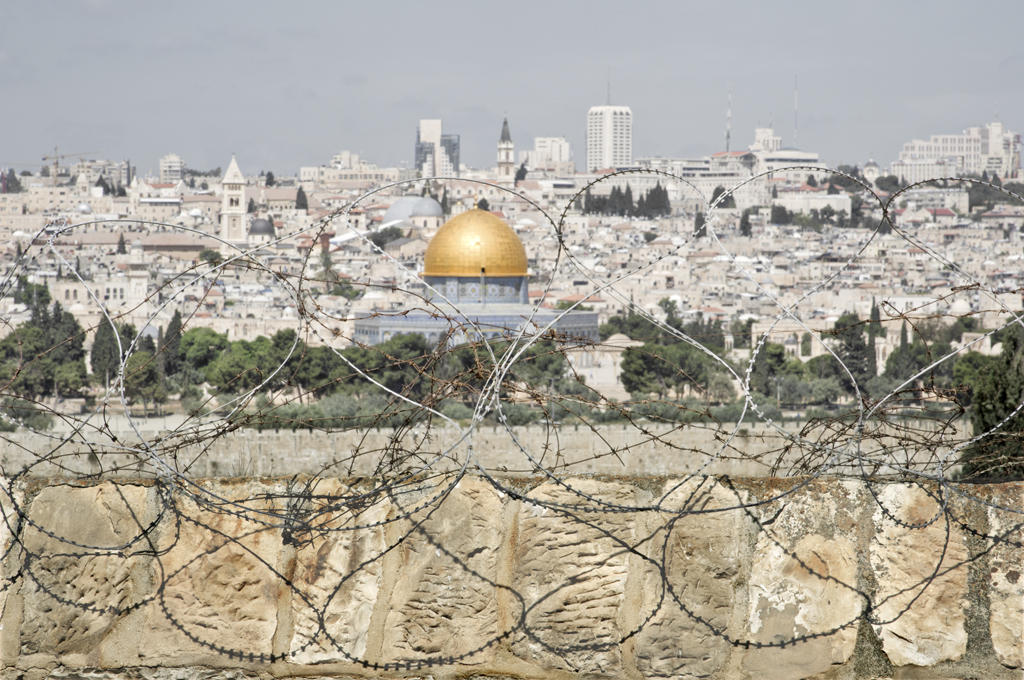
Dome of the Rock, Haram al-Sharif, Jerusalem

Access has been controlled and contested for thousands of years in the Old City.

Dome of the Rock, Seen from the Mount of Olives, Jerusalem 2011

© Leslie Hossack

The world’s three great monotheistic religions have sacred sites in the Old City, and access has been controlled and contested for thousands of years. The Dome of the Rock, a Muslim Mosque built in 691 CE, sits atop the Foundation Stone on the Temple Mount. Seen here, the golden dome glows in the sunshine. In 1993, King Hussein of Jordan donated $8.2 million to fund 80 kilograms of gold to cover the dome.

On 29 November 1947, the United Nations passed a resolution calling for the establishment of a Jewish State. The State of Israel was declared on 14 May 1948, the day the British Mandate in Palestine ended. From 1948 to 1967, Jordan controlled East Jerusalem, and Israelis could not go to the Western Wall. During the 1967 Six-Day War, Israel occupied the Old City, but allowed the Muslim Religious Trust to manage “Haram al-Sharif” (the Temple Mount).

Since 1967, Jews have been able to visit the Western Wall. Today, anyone wishing to enter the Western Wall plaza must pass through strict airport style security. Visitors to Haram al-Sharif must pass through similar, but separate, security checks; however, men and women in immodest dress are not granted entrance. Non-Muslim visitors are not permitted to pray there or to enter the Dome of the Rock.

Life in Israel seems to revolve around issues of access and security in public spaces, both sacred and secular – from the Dome of the Rock and the Western Wall, to shopping malls and parking garages.

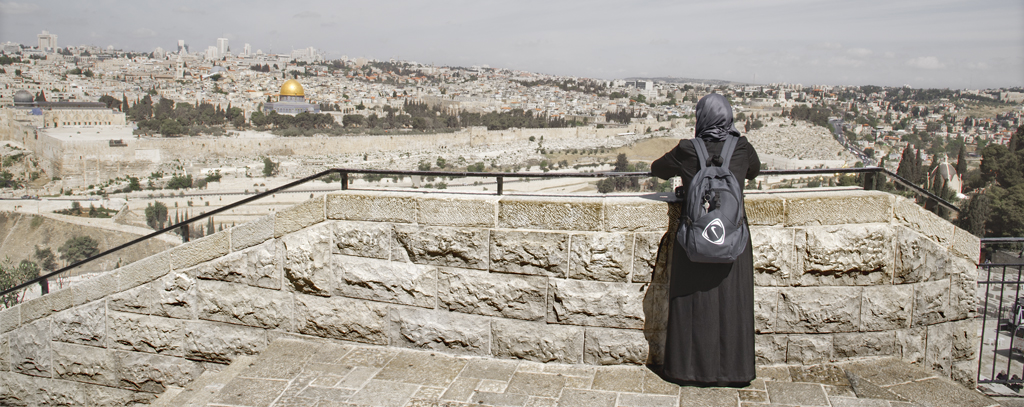
Gazing at the Dome of the Rock, Jerusalem

“Who is the owner of the language of this land? Who loves it more?

Woman Gazing at the Dome of the Rock, Jerusalem 2011

© Leslie Hossack

Located inside the Old City, the golden Dome of the Rock is situated within the walls of the Temple Mount, a holy place for Muslims and Jews. Covering an area of 35 acres, the Temple Mount remains under the control of Muslim religious authorities; however, responsibility for security was taken over by Israelis after their occupation of East Jerusalem in 1967.

In this photograph, the woman gazing at the Dome of the Rock is standing near the top of the Mount of Olives, looking out over the Jewish cemetery immediately beneath her. Across the valley, the Yusefiya Muslim Cemetery lies outside the walls of the Old City.

Muslims make up approximately 16% of the Israeli population while Jews make up 75% of the total population currently estimated at 7,746,000. Over 700,000 Palestinians are citizens of Israel, living inside the country’s 1949 armistice borders. About 1.2 million live in the West Bank (including 200,000 in East Jerusalem) and about one million in the Gaza Strip. (Middle East Research and Information Project) Israel is a place of complexities and inequities.

Mahmoud Darwish was widely regarded as the Palestinian national poet. He admired Hebrew poet Yehuda Amichai, but described his poetry as a “challenge to me, because we write about the same place. He wants to use the landscape and history for his own benefit, based on my destroyed identity. So we have a competition: who is the owner of the language of this land? Who loves it more? Who writes it better?”

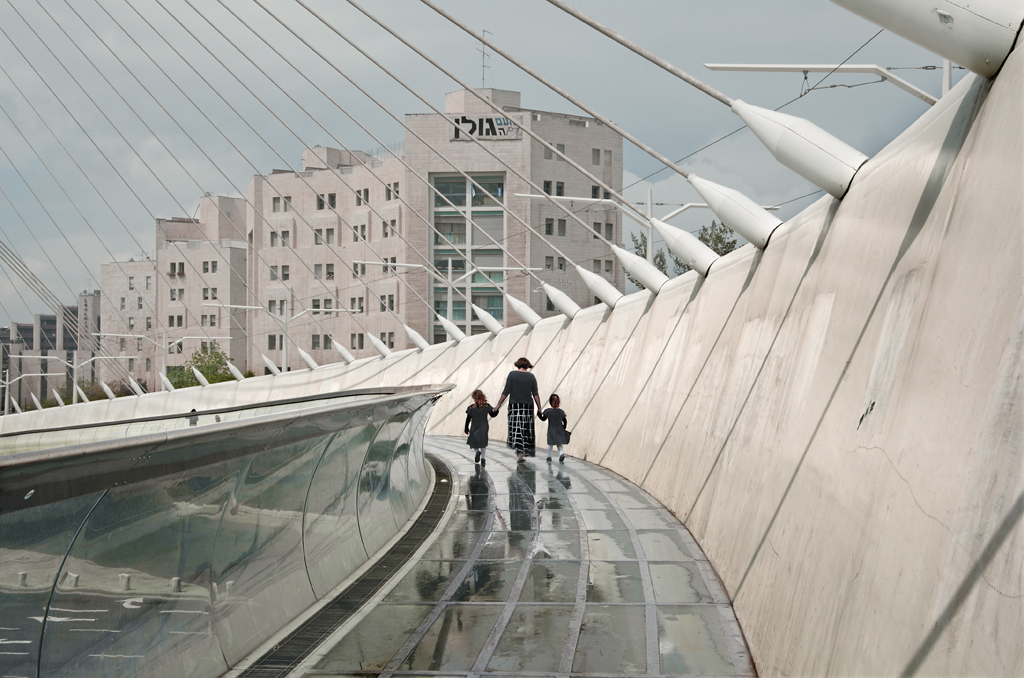
Calatrava’s Bridge of Strings, Jerusalem

Bridges are instruments of peace and make a lot of sense in a city like Jerusalem.


Bridge of Strings, Jerusalem 2011

© Leslie Hossack

The Bridge of Strings was designed Santiago Calatrava, world-renowned Spanish architect, engineer and artist. Calatrava is celebrated for his many striking structures scattered around the globe, including the Galleria in Toronto’s Brookfield Place, and the 2004 Olympic Stadium in Athens. Interestingly, the roof that Calatrava designed for the Athens Olympic Stadium is reminiscent of the roof added to the 1936 Berlin Olympic Stadium during renovations completed in 2004.

The Bridge of Strings, now the tallest structure in Jerusalem, is a new landmark at the eastern entrance to the city. When driving in from Ben Gurion, Israel’s international airport in Tel Aviv, this daringly modern bridge is a stunning surprise. The bridge is supported by a 118-metre high tower that supports 66 steel cables. The exterior of the bridge is clad in Jerusalem stone, and accented with steel, glass and concrete.

Calatrava said he wanted to design one of the most beautiful bridges for one of the oldest cities. He added: “Bridges are instruments of peace … They are built for the sake of progress and for the average citizen … A bridge makes a lot of sense in a city like Jerusalem.”

This S-shaped bridge serves both light rail trains and pedestrians. In Jerusalem, the public transportation system does not run on Shabbat. The family in this photograph was out for a walk, dressed in their Shabbat finery. The little girls clearly delighted in crossing the bridge from one side to other, and back again.

Architect:  Santiago Calatrava     Date:  2008

Children’s Holocaust Memorial, Jerusalem

effervescent lives about to come to an abrupt, catastrophic, unforeseeable end

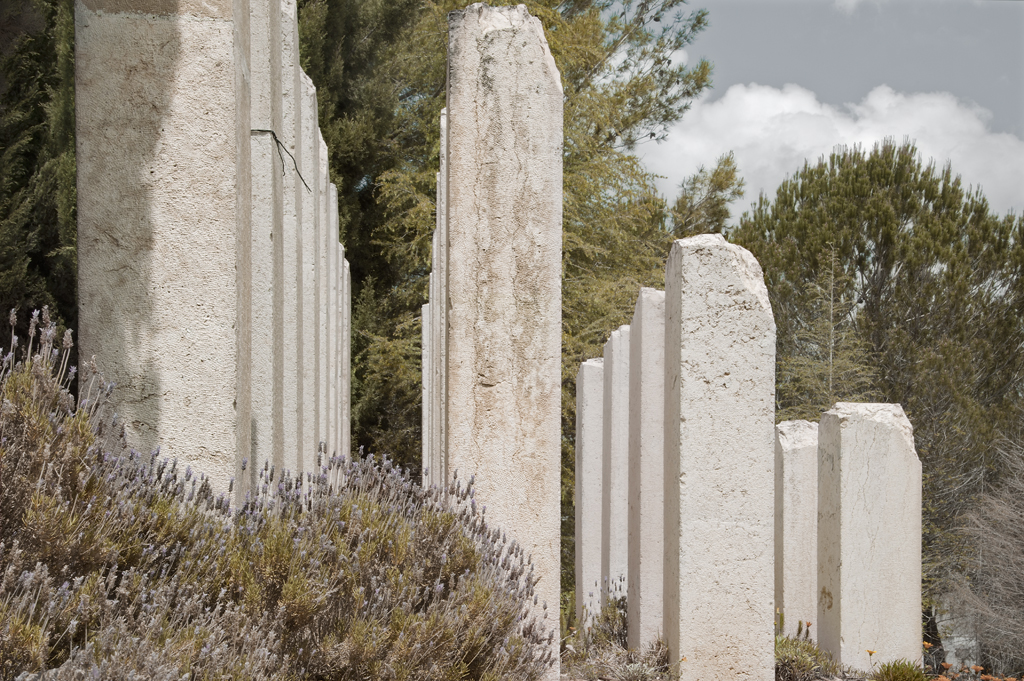
Children’s Holocaust Memorial, Yad Vashem, Jerusalem, 2011

© Leslie Hossack

The first building designed by Moshe Safdie at Yad Vashem was the Children’s Holocaust Memorial. It is a cave-like structure filled with tiny dots of candlelight and the sound of a voice reading the names of the murdered children, their ages, and their countries of origin. To name the names of Holocaust victims is one of the missions of Yad Vashem, and it was recently announced that they have collected the names of four million Jewish victims.

Of the six million who died in the Holocaust, it is estimated that: “the Germans and their collaborators killed as many as 1.5 million children, including over a million Jewish children and tens of thousands of Romani (Gypsy) children, German children with physical and mental disabilities living in institutions, Polish children, and children residing in the occupied Soviet Union.” (United States Memorial Holocaust Museum) The overall numbers are staggering, but impossible to comprehend. It is the power of the specific that is more easily understood: Uziel Spiegel, age two and a half, murdered at Auschwitz.

Uziel’s parents Abe and Edita Spiegel were Auschwitz survivors who donated funds for the construction of the Children’s Holocaust Memorial. This photograph shows a cluster of 20 stone pillars outside the entrance. Each pillar is broken off at the top, bringing to mind the million and a half children whose “ordinary but effervescent lives were about to come to an abrupt, catastrophic, and unforeseeable end.” (Avner Shalev, Building a Holocaust Museum in Jerusalem)

Architect:   Moshe Safdie     Date:   1987

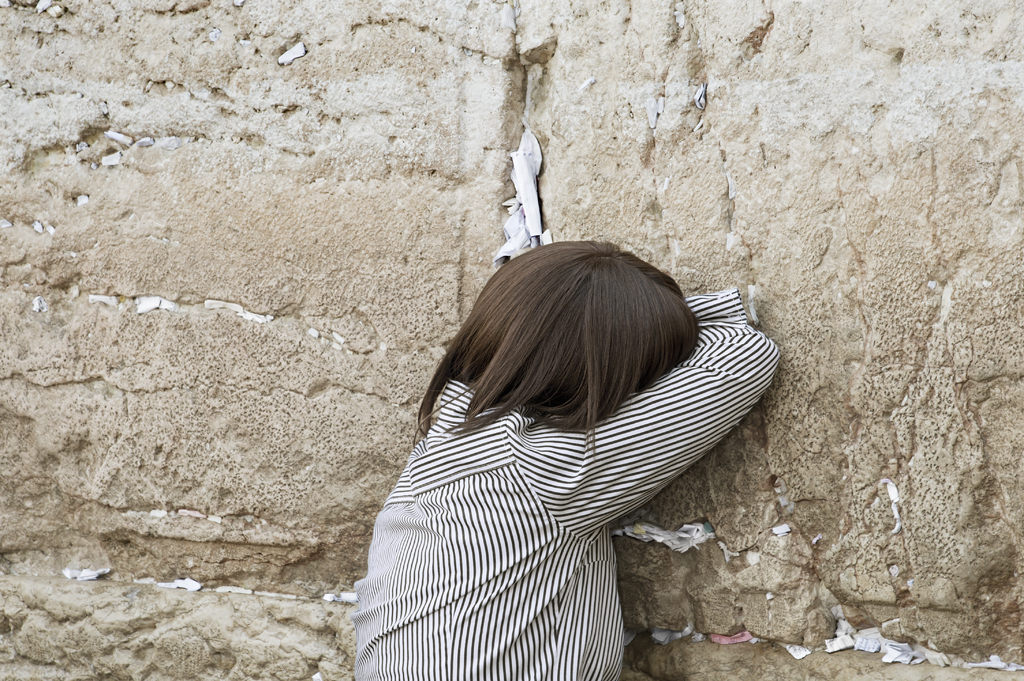
Praying at the Western Wall, Jerusalem

“Jerusalem is full of used Jews, worn out by history…”

Woman Praying, Western Wall, Jerusalem 2011

© Leslie Hossack

Jerusalem is full of used Jews, worn out by history,
Jews second-hand, slightly damaged, at bargain prices.

And the eye yearns toward Zion all the time. And all the eyes
of the living and the dead are cracked like eggs
on the rim of the bowl, to make the city
puff up rich and fat.

Jerusalem is full of tired Jews,
always goaded on again for holidays, for memorial days,
like circus bears dancing on aching legs.

excerpt from Jerusalem Is Full of Used Jews, in Poems of Jerusalem and Love Poems, by Yehuda Amichai

The lines above are taken from the same poem that I quoted yesterday, written by the celebrated Israeli poet Yehuda Amichai. He was born in 1924 in Germany to an Orthodox Jewish family that immigrated to British Palestine in 1935 and settled in Jerusalem. When he was 22, Amichai started writing poetry, and he later became poet in residence at several universities, including Berkeley, New York University, and Yale.

Amichai was a soldier, a teacher, a scholar, and an internationally acclaimed poet. He wrote in Hebrew, and his works have been translated into more than 35 languages. Yehuda Amichai is also known as a peace advocate who worked with many Arab writers and Palestinian poets. He is quoted as saying: “I have no illusions. It’s quite difficult for poets to communicate with one another in a society that is politically torn apart the way ours is.” Amichai continued to live in Jerusalem until his death in 2000.

Women at the Western Wall, Jerusalem

“What does Jerusalem need? It doesn’t need a mayor, it needs a ring-master…”

Three Women at the Western Wall, Jerusalem 2011

© Leslie Hossack

The Western or Wailing Wall is a 187-foot long section of ancient wall located on the western side of the Temple Mount. It is a retaining wall built by Herod the Great around 19 BCE. He expanded the plateau where the First and Second Temples stood, creating a wide expanse which is still called the Temple Mount. In 70 CE, Romans destroyed the Second Temple, and subsequently the Western Wall became the holiest of all Jewish sites.

Today, tension still surrounds this sacred place. In order to enter the huge plaza in front of the Western Wall, visitors must pass through airport style security. The fenced off prayer area at the base of the wall is divided into a large men’s section and a smaller women’s section. In the women’s section, most individuals are engaged in silent prayer and contemplation, and many visitors place written prayers in the cracks between the stones. These enormous pieces of limestone weigh between two and eight tons each. Altogether, the wall consists of 45 rows of stones, 28 above ground and 17 underground.

What does Jerusalem need? It doesn’t need a mayor,
it needs a ring-master, whip in hand,
who can tame prophecies, train prophets to gallop
around and around in a circle, teach its stones to line up
in a bold, risky formation for the grand finale

Later they’ll jump back down again
to the sound of applause and wars.

excerpt from Jerusalem Is Full of Used Jews, in Poems of Jerusalem and Love Poems, by Yehuda Amichai

The Western Wall, Jerusalem

For centuries, the Western Wall has been a site for Jewish prayer and pilgrimage.

Men’s Section, Western Wall, Jerusalem 2011

© Leslie Hossack

The Old City of Jerusalem covers approximately one square kilometer, and is divided into the Armenian, Jewish, Muslim, and Christian Quarters. Inside the city walls, there are many holy sites sacred to Muslims, Christians and Jews, including the Al-Aqsa Mosque, the Church of the Holy Sepulchre, and the Western Wall.

The Western or Wailing Wall is located at the base of the western side of the Temple Mount. It is a remnant of the ancient wall that surrounded the Jewish Temple’s courtyard, and it is one of the most sacred places in Judaism, after the Temple Mount itself. Much of the wall was built by Herod around 19 BCE.

For centuries, the Western Wall has been a site for Jewish prayer and pilgrimage. With the rise of the Zionist movement in the early 20th century, the wall became a source of friction between Muslims and Jews. After the 1948 Arab-Israeli War, the wall came under Jordanian control; Jews were barred from the site for 19 years, until Israel occupied the Old City in 1967.

The men’s section of the Western Wall is always bustling with activity. Many Bar Mitzvahs take place here, and a Torah cabinet is visible in this photograph. A number of men are wearing the tefillin, two small black boxes with straps; these boxes contain tiny scrolls upon which are written four Biblical passages. At the base of the wall, individuals engage in private prayer, tourists take pictures, and larger groups participate in special events.

Looking West to the Judean Desert, Masada

The natural approaches to the fort, including the Snake Path, are very difficult.

Inside the Fortress Looking West to the Judean Desert, Masada 2011

© Leslie Hossack

Located between the Judean Desert and the Dead Sea, Masada sits on a plateau whose western side drops 300 feet to the desert floor. The natural approaches to the fort are very difficult, including the Snake Path still used today, but only by the fittest; most ride the cable car. After the 1967 Six-Day War and Israel’s capture of the West Bank, a road was built from Jerusalem via Jericho, along the shore of the Dead Sea to Masada and beyond.

In this photograph, the Judean Desert can be seen beyond the remnants of the ancient fortress walls. Originally, a wall 12 feet high and 4,300 feet long ran around the perimeter of the plateau. Today, the wall is much lower, but still solidly in place. In addition to the wall, visitors can see clear evidence of the commandant’s residence, Northern Palace, bathhouse, cisterns, public pools, guardroom, officers’ quarters, synagogue, storerooms, and also the rebel dwellings used as living quarters at the time of the Great Revolt.

The Judean Desert is a relatively small desert, covering 580 square miles of Israel’s total area of 7,992 square miles. Israel stretches 263 miles north to south, and its width ranges from 71 miles to just over nine miles. Located at the eastern end of the Mediterranean Sea, Israel lies at the junction of Europe, Asia and Africa. It is bordered by Lebanon to the north, Syria to the northeast, Jordan and the West Bank to the east, and Egypt to the southwest.

Looking East to the Dead Sea, Masada

“Masada shall not fall again.”

Inside the Fortress Looking East to the Dead Sea, Masada 2011

© Leslie Hossack

Masada, a hilltop fortress built by King Herod, was declared a UNESCO World Heritage Site in 2001. Masada sits on a plateau that rises approximately 1,475 feet above the Dead Sea. In this photograph, the Dead Sea can be seen beyond the ancient walls of the fortress; on a clear day, the hills of Jordan are visible in the distance. The Dead Sea, located in the Jordan Rift Valley, is the lowest point on the earth’s surface at approximately 1,400 feet below sea level.

The story of Masada is legendary. After Rome destroyed Jerusalem and the Second Temple in 70 CE, a number of Jewish freedom fighters fled to the fortress at Masada. In 73 CE, the Roman Tenth Legion laid siege to the fort. When it became apparent that the Romans were going to breach the walls, the 960 Jewish inhabitants burned all the buildings and committed mass suicide rather than be taken prisoners. Josephus writes that ten men were chosen by lot to kill all the inhabitants, and then one of these ten men was chosen by lot to slay the other nine, and lastly himself.

This saga gave rise to the phrase: “Masada shall not fall again.” Israeli army cadets who take their oath of allegiance at the fortress make this pledge. It is interesting to note that when new members of the Israeli Defense Forces are sworn in, the ceremonies are often held at sites of national historic interest, such as the Western Wall and Masada.