Nazi architecture: the Zehlendorf SS settlement

Semi-Detached House, Zehlendorf, Berlin 2010

© Leslie Hossack

The mammoth neo-classical architecture that Albert Speer hoped to realize in the Berlin city centre had little impact on daily construction in the Third Reich. Most of the residential buildings and settlements … were given a more traditional form. The buildings had steep tile roofs; the windows could be closed with shutters. The appearance of half-timbered construction gave the houses a local flare. A typical example of this is the Zehlendorf SS settlement built in 1938 – 1940 in Berlin that now bears the name Waldsiedlung Krumme Lanke.                                                                                             – Matthias Donath, Architecture in Berlin 1933 – 1945, A Guide Through Nazi Berlin

The Nazis built housing for their SS troops on the west side of Berlin in Zehlendorf, on the shores of Krumme Lanke. The SS or Schutzstaffel (Protection Squadron or defence corps) was a major paramilitary organization under Hitler and the Nazi Party. Built upon the Nazi ideology, the SS was responsible for many of the crimes against humanity during WW II. After 1945, the SS was banned in Germany, along with the Nazi Party, as a criminal organization. wikipedia.org/wiki/Schutzstaffel

The photograph above shows a typical example of what Matthias Donath refers to as a traditional residential settlement, consisting of houses with steep tile roofs and shuttered windows. These detached, semi-detached and terraced houses were allocated to SS officers according to rank.

To see examples of what Donath refers to as the mammoth neo-classical architecture that Albert Speer hoped to construct for Hitler’s  new world capital Germania, please see my previous posts of the 1936 Berlin Olympic Stadium and Tempelhof Airport.

BERLIN STUDIEN – fine art photography book

BERLIN STUDIEN  selected as finalist in Photography Book Now 2011 International Juried Competition

BERLIN STUDIEN was selected for People’s Choice voting and will go on to the final round of the Photography Book Now 2011 competition judging. This year, more than 2,000 books were submitted.

To vote for your favorite book by August 30, please visit:

http://photographybooknow.blurb.com/peoples-choice/category/documentary

BERLIN STUDIEN, photographic studies of historic Berlin today, includes my photographs from Berlin which I have been posting on Haute Vitrine for the past few weeks. It also includes the images of my Studio 255 colleagues Barbara Bolton, Abigail Gossage and Patricia Wallace. Working with these three fabulous women, along with our coach Michael Tardioli, as I designed and edited this book was, as always, an absolute pleasure!

BERLIN STUDIEN, a photographic study of historic Berlin today, is a collection of sumptuous images exploring one of the world’s most infamous cities – Berlin, a city with a past. Berlin reveals its history as raw scars clearly visible at every turn. Like the city itself, this volume both delights and disturbs.

How do you commemorate Berlin’s past without memorializing madness and trivializing victims? Berliners, and anyone attempting to photograph their city, must try to come to terms with acknowledging the past, while at the same time not exploiting it. This challenge was taken up by four Canadian photographers: Barbara Bolton, Abigail Gossage, Leslie Hossack and Patricia Wallace. In 2010 they travelled to Berlin where they explored Nazi architecture, Holocaust history, Stasi relics, and the quieter side of life in the city today.

The result is a collection of photographs that are sensuous and seductive, stark and spectacular, understated and engaging. BERLIN STUDIEN acknowledges the city’s tragic past, while at the same time celebrating its current status as a vibrant world capital. This is an anthology of revealing images that are in turn dramatic, disturbing, gentle, monumental. They explore the diabolical and the humble, the past and the present, the famous and the forgotten. Above all, these are truthful images. They provide an honest examination of Berlin today, after centuries of conflict and recent reunification.

Each photograph in BERLIN STUDIEN is accompanied by a descriptive text created by the artist. This volume also features a foreword by Michael Tardioli and an essay by Michael Schreier.

© Leslie Hossack

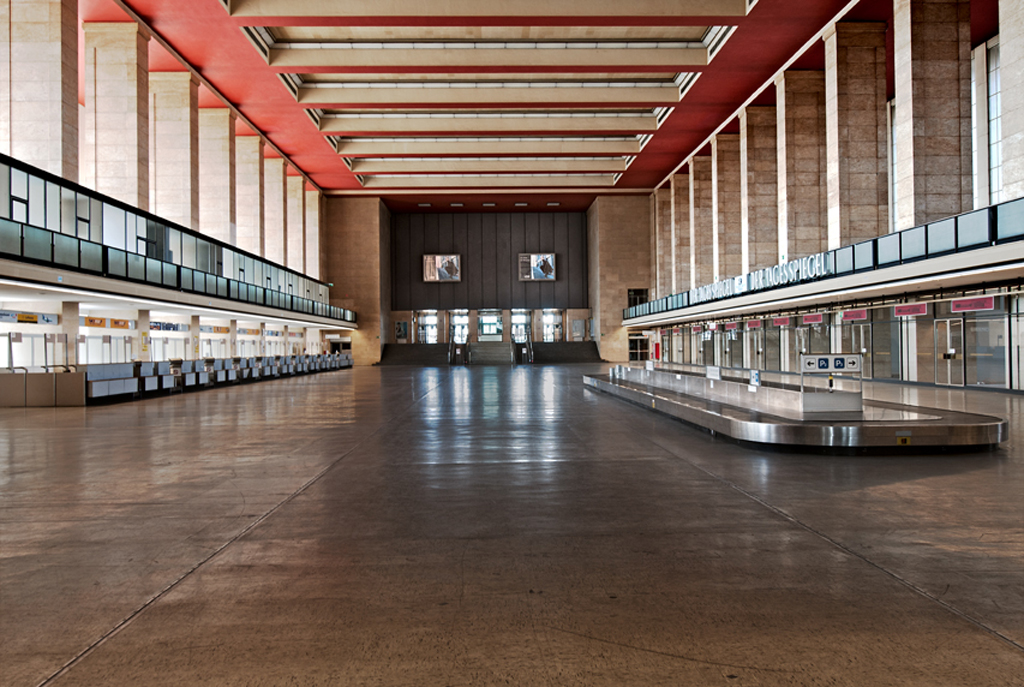
Central Hall, Tempelhof Airport

Tempelhof Berlin used to be one of the world’s largest and busiest airports.

Central Hall, Tempelhof Airport, Berlin 2010

© Leslie Hossack

Tempelhof Airport is a registered historic monument. The site was originally Knights Templar land in medieval Berlin, and this is the origin of the name Tempelhof. In 1909, Armand Zipfel made the first flight demonstration at Tempelhof, followed by Orville Wright that same year.

In 1923, Tempelhof was officially designated an airport. As part of Albert Speer’s plan for the reconstruction of Berlin, Ernst Sagebiel was ordered to replace the old terminal with a new building in 1934. Designed in monumental Nazi style, Sagebiel’s main entrance doors open into a four-story high Hall of Honour. From there, stairs lead down into the central hall shown in this photograph. Here the walls are divided by rectangular columns and high windows, and from galleries suspended on either side, visitors watched passenger operations.

At one time Tempelhof was the central airport for the city and the largest building in Berlin. During WW II, several basement rooms under the administrative building were finished as air-raid shelters for Lufthansa and airport employees, and for people from the neighborhood. Damaged during the war, the airport complex underwent additional changes from 1959 to 1962.

After the fall of the Berlin Wall and German reunification, the Allied occupation of Berlin came to an end. In July 1994, the British, French and American forces were deactivated in a ceremony on the Four Ring Parade Field at Tempelhof, and the Western Allies returned the city of Berlin to the German government.

Architect: Ernst Sagebiel          Date: 1935-1941

Canopy Roof and Tarmac, Tempelhof Airport

Tempelhof Berlin was built in classic Nazi “monumental”style.

Canopy Roof and Tarmac, Tempelhof Airport, Berlin 2010

© Leslie Hossack

Nazi government buildings such as Tempelhof Airport were generally built in a monumental style designed to intimidate the individual and exalt the state. Sometimes, two different styles were used in the same structure. The street side of Tempelhof has an imposing classic appearance, while the airfield side, with its steel gate construction, looks modern and almost transparent.

Inside the airport, the huge departure hall is 1.2 km long. Outside, the flight gates are covered by a canopy-style roof to protect passengers from the elements. These flight gates and the projecting steel roof form an enormous semicircular apron that was designed to resemble an eagle in flight with outspread wings. The roof of the main airport hall was built to support bleachers to allow up to 65,000 spectators to watch flight demonstrations, but the stands were never completed.

The plane in this photograph is the last one at Tempelhof. It sits alone on the tarmac in stark contrast to the time when the airport was the busiest in the world. Tempelhof was the site of the 1948-49 Berlin Airlift when the Soviet authorities closed off Berlin. The Western Powers sustained the city by providing essential supplies by air, landing at the rate of one plane every three minutes. Later, during the Cold War, Tempelhof was the main terminal for American planes accessing Berlin.

Tempelhof Airport was officially closed on October 30th, 2008, and it is still awaiting news of its fate. In May 2010, the outfield at Tempelhof was opened as Berlin’s largest public park and named “Tempelhofer Feld.”

Architect: Ernst Sagebiel          Date: 1935-1941

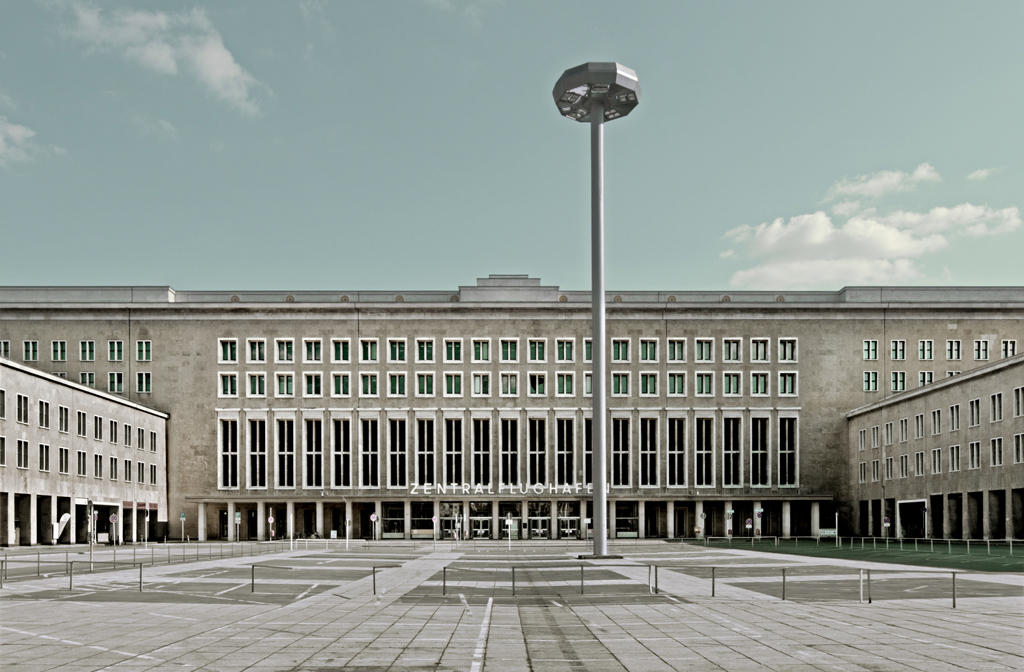
Entrance Plaza, Tempelhof Airport

Tempelhof Berlin was once described as “the mother of all airports.”

Entrance Plaza, Tempelhof Airport, Berlin 2010

© Leslie Hossack

Tempelhof Airport was described by the renowned British architect Sir Norman Foster as “the mother of all airports.”

Built by the Nazis, Tempelhof was taken by the Soviets during the Battle of Berlin at the end of WW II. Shortly thereafter, the airport was turned over to the United States as part of the American occupation of Berlin.

In 1937, Hitler had appointed his favourite architect, Albert Speer, to the position of “General Building Inspector for the Redesign of the Reich Capital.” Tempelhof was built in line with Speer’s grandiose plans to expand Berlin into a global capital called Germania.

Nazi administration buildings such as Tempelhof Airport were built in a monumental style that reduced design to its essentials. This approach is distinguished by smooth unadorned surfaces that appear severe and two-dimensional. The National Socialist style is often characterized by a reinforced concrete frame that is clad in natural stone; façades are flat and symmetrical, and window frames are rectangular with sharp edges.

Tempelhof Airport is a typical example, with its identical rows of windows. The large entrance plaza seen in this photograph is framed by three-story wing structures on either side of the massive five-story reception building with its 21 entrance doors. A 45-metre-high Reich eagle sat on the roof of the main building until 1962; today, only its head is left on display in front of the plaza.

Architect: Ernst Sagebiel          Date: 1935-1941

Cauldron, 1936 Olympic Stadium

The 1936 Berlin Olympics marked the first time that a torch relay was run from Olympia to the site of the games.

Cauldron, 1936 Olympic Stadium, Berlin 2010

© Leslie Hossack

The 1936 Olympic Games were the largest to date; they involved approximately 4,000 athletes from 49 nations, and 3.8 million spectators. It was the first time that the games received worldwide radio coverage, and there were TV broadcasts as well. The Nazis were masters of symbols, pageantry, communication and propaganda.

The Berlin Olympics also marked the first time ever that a torch relay was run from Olympia to the site of the games. The cauldron, located just inside the Marathon Gate of the Olympic Stadium, is Germanic in design with its clean, unadorned lines. Like all Nazi architecture, it is intended to look durable, permanent, timeless. Hitler decreed that the Olympic Stadium be constructed entirely of German materials, and this was true for the cauldron as well, which is made of steel on concrete.

Clearly visible in this photograph is the new roof of the stadium, added during the 2000-2004 modernization. The cantilevered construction is made up of a steel framework covered by a membrane, except for the outermost 13 metres which are glazed. Integral to this new roof are state of the art lighting and sound systems.

The renovated stadium now seats 74,228 people, not 100,000 as it did originally. On the right hand side of this image you can see the VIP boxes which look the same as they did when Reich Chancellor Adolf Hitler stood there, in the so-called Führer’s box, and officially opened the Berlin Olympic Games.

Architect: Werner March                         Date: 1936

Conversion Architects: GMP                  Date: 2000-2004

East Gate, 1936 Olympic Stadium

75 years ago, in August 1936, the XI Games took place in the Berlin Olympic Stadium.


East Gate, 1936 Olympic Stadium, Berlin 2010

© Leslie Hossack

The East Gate of the stadium, also known as the Olympic Gate, is made up of the Bavarian Tower and the Prussian Tower; together they support the Olympic Rings. Although modernized in 2000-2004, the stadium as seen in this photograph looks much as it did for the XI Olympic Games.

In 1933, Hitler personally intervened in the design of the stadium; he had his architect Albert Speer modify its outward appearance to keep it more in line with the Colosseum in Rome. The Berlin stadium, made of reinforced concrete, was covered with a veneer of limestone at Speer’s suggestion. There are 136 columns supporting the two-story arcade around the outside of the oval arena that held 100,000 spectators.

Architecture in The Third Reich was used to express the power of the state, and massive buildings were designed to symbolize Germany’s international standing. Hitler said he wanted to see eternal works built in Berlin, “comparable only to Ancient Egypt, Babylon and Rome.” The Nazis used the Olympics as a showcase for the National Socialist dictatorship; however, these games are now often referred to as the Propaganda Games. At the same time as Hitler was opening the games on August 1st, 1936, forced labour was being used only 35 km away to build Sachsenhausen Concentration Camp.

After WW II, the British occupied the Olympic site until 1994. Following the recent renovations, the stadium hosted the 2006 FIFA World Cup and it is now home to Hertha BSC, Berlin’s soccer club.

Architect: Werner March               Date: 1936

Conversion Architects: GMP        Date: 2000-2004

VIP Stairway, 1936 Olympic Stadium

Exactly 75 years ago, on August 1st, 1936, Hitler opened the XI Games in the Berlin Olympic Stadium.

VIP Stairway, 1936 Olympic Stadium, Berlin 2010

© Leslie Hossack

Exactly 75 years ago, on August 1st, 1936, Hitler mounted these stairs in the Berlin Olympic Stadium, entered his VIP box, and officially opened the XI Games. The Nazis used the Olympics as a showcase for their National Socialist dictatorship; however, these games are now often referred to as the Propaganda Games. At the same time that Hitler was opening the games, forced labour was being used only 35 km away to build Sachsenhausen Concentration Camp.

The Third Reich used “monumental” architecture to exalt the state and diminish the individual. In 1933, Hitler personally intervened in the design of the Olympic Stadium; he had his architect Albert Speer modify its outward appearance to keep it more in line with the Colosseum in Rome. The Berlin stadium, made of reinforced concrete, was covered with a veneer of limestone at Speer’s suggestion. Following the Olympics, Hitler attended many National Socialist events in the stadium. During a state visit in 1937, Hitler and Mussolini mounted these stairs and stood together to watch a nighttime rally in the arena. The spectacle included a “Dome of Light” created by Albert Speer using anti-aircraft searchlights.

During the recent modernization of the 1936 Olympic Stadium, the outside appearance was preserved as much as possible, with the exception of the new roof. However, the inside of the stadium was completely redesigned, except the rooms behind the VIP section which are protected by conservation laws. The stairs in this photograph are located in the protected area, and they lead up to the Balcony of Honour. It is said that during the Nazi regime, when it was time to leave the VIP lounge and go up to the Führer’s Box, Hitler alone would use these stairs and others would be directed to a different stairway.

Architect: Werner March          Date: 1936

Conversion Architects: GMP   Date: 2000 – 2004