SIR WINSTON CHURCHILL’S POLITICAL YEARS

CHARTING CHURCHILL, 1874 – 1965

Part 3, The Political Years, 1908 – 1929

On November 30th 2014, Sir Winston Churchill’s 140th birthday, Haute Vitrine started publishing images from the series THE CHURCHILL PHOTOGRAPHS by Leslie Hossack.

Yesterday’s post marked the end of Part 3, The Political Years, 1908 – 1929. During this time, Sir Winston Churchill’s political career was firmly established; he contested eleven elections and won seven; he held nine cabinet offices, including Chancellor of the Exchequer, and delivered five budget speeches. Photographs featured in Part 3, The Political Years can be reviewed below.

To view the photographs from Part 1, The Early Years, 1874 – 1892 and Part 2, The Defining Years, 1892 – 1908, please visit the Haute Vitrine posts of November 30th through December 20th, 2014.

Leslie Hossack’s CHARTING CHURCHILL will continue into January 2015, the month that marks the 50th anniversary of the death of Sir Winston Churchill.


33 Eccleston Square, London 2014 by Leslie Hossack
33 Eccleston Square, London 2014

Old Admiralty Building, Whitehall, London 2014 by Leslie Hossack

Old Admiralty Building, Whitehall, London 2014

Admiralty Arch, The Mall, London 2014 by Leslie Hossack

Admiralty Arch, The Mall, London 2014

The Cenotaph, Whitehall, London 2014 by Leslie Hossack

The Cenotaph, Whitehall, London 2014

State Dining Room, Blenheim Palace, Woodstock 2014 by Leslie Hossack

State Dining Room, Blenheim Palace, Woodstock 2014

The House at Chartwell, Westerham, Kent 2014 by Leslie Hossack

The House at Chartwell, Westerham, Kent 2014

The Lake at Chartwell, Westerham 2014 by Leslie Hossack

The Lake at Chartwell, Westerham, Kent 2014
The Goldfish Pool at Chartwell, Westerham 2014 by Leslie Hossack

The Goldfish Pool at Chartwell, Westerham, Kent 2014

11 Downing Street, London 2014 by Leslie Hossack

11 Downing Street, London 2014

Horse Guards  Parade, London 2014 by Leslie Hossack

Horse Guards Parade, London 2014

© Leslie Hossack

The images featured above are part of the limited edition collector’s portfolio created by Leslie Hossack to mark the 50th anniversary of the death of Sir Winston Churchill. She presents locations that chart Churchill’s personal and political life, from his birth at Blenheim Palace in 1874 until his death in London in 1965. To find out how these images are linked to Churchill, please see the previous posts here on Haute Vitrine.

THE CHURCHILL PHOTOGRAPHS are part of Hossack’s larger body of work that explores Nazi architecture in Berlin, Stalinist structures in Moscow, contested sites in Jerusalem, a Cold War bunker in Ottawa, NATO’s Headquarter Camp in Kosovo, and buildings linked to the Japanese Canadian internment during World War II.

To view more photographs, please visit Leslie’s website.  lesliehossack.com

Charting Churchill: Horse Guards Parade, London

Horse Guards  Parade, London 2014 by Leslie Hossack

Horse Guards Parade, London 2014

© Leslie Hossack

On the November 7th 1924, Winston Churchill was appointed Chancellor of the Exchequer in the Conservative government of Stanley Baldwin. In January 1925, his family moved into the official residence of the Chancellor of the Exchequer located at 11 Downing Street. This was the second time in his career that Winston had held a cabinet post with an official residence backing onto Horse Guards Parade. The first time was in 1911 when he was appointed First Lord of the Admiralty. He and his family had lived in Admiralty House from 1913 to 1915, and he later described those years as “the happiest of my life.”

While serving as Chancellor of the Exchequer from 1925 to 1929, Churchill delivered five budget speeches. In addition, in 1927 he found time to visit Mussolini in Rome; to publish The World Crisis, Volume III, 1916-1918; and to take up bricklaying at Chartwell. By the beginning of 1929, Winston’s career appeared to be at its zenith, and in March he published Volume IV of The World Crisis, The Aftermath. However, in May 1929, Mr. Baldwin’s government was defeated and Churchill resigned as Chancellor of the Exchequer. It was time to leave the official residence at 11 Downing Street.

In the photograph above, the back garden walls of No. 10 and No. 11 Downing Street are directly behind the viewer. The red building seen across the parade square is the Old Admiralty Building. Although Churchill was about to enter his “Wilderness Years” at the end of 1929, he would return to both The Admiralty and to Downing Street many years later.

The image featured above is part of the limited edition collector’s portfolio created by Leslie Hossack to mark the 50th anniversary of the death of Sir Winston Churchill. She presents locations that chart Churchill’s personal and political life, from his birth at Blenheim Palace in 1874 until his death in London in 1965. THE CHURCHILL PHOTOGRAPHS are part of Hossack’s larger body of work that explores Nazi architecture in Berlin, Stalinist structures in Moscow, contested sites in Jerusalem, a Cold War bunker in Ottawa, NATO’s Headquarter Camp in Kosovo, and buildings linked to the Japanese Canadian internment during World War II.

To view more photographs, please visit Leslie’s website.  lesliehossack.com

Charting Churchill: 11 Downing Street, London

11 Downing Street, London 2014 by Leslie Hossack

11 Downing Street, London 2014

© Leslie Hossack

For Winston Churchill, 1924 was a milestone year. In 1922, after an appendectomy, he had lost the election in Dundee and found himself “without a seat, without an office, without a party, and without an appendix.” However, in 1924, he was elected in Epping; he was back in the House of Commons and he was back in the cabinet. November 7th 1924, Winston was appointed Chancellor of the Exchequer in the Conservative government of Stanley Baldwin. That same month, he turned 50.

Churchill had not been idle during the two years he was out of Parliament. He had been busy working on his book, The World Crisis, and volumes I and II were published in 1923. He had also been busy renovating his new country home, Chartwell. The family took up residence there in 1924, just months before Winston was appointed to one of Great Britain’s most prestigious cabinet positions. Subsequently, the family moved into the official residence of the Chancellor of the Exchequer at 11 Downing Street. In the photograph above, the dark gray building near the end of the right-hand side of the street houses both No. 10 and No. 11 Downing Street. The residence of the Chancellor of the Exchequer is the further of the two, its dark facade painted white at ground level.

The image featured above is part of the limited edition collector’s portfolio created by Leslie Hossack to mark the 50th anniversary of the death of Sir Winston Churchill. She presents locations that chart Churchill’s personal and political life, from his birth at Blenheim Palace in 1874 until his death in London in 1965. THE CHURCHILL PHOTOGRAPHS are part of Hossack’s larger body of work that explores Nazi architecture in Berlin, Stalinist structures in Moscow, contested sites in Jerusalem, a Cold War bunker in Ottawa, NATO’s Headquarter Camp in Kosovo, and buildings linked to the Japanese Canadian internment during World War II.

To view more photographs, please visit Leslie’s website.  lesliehossack.com

Charting Churchill: The Goldfish Pool at Chartwell

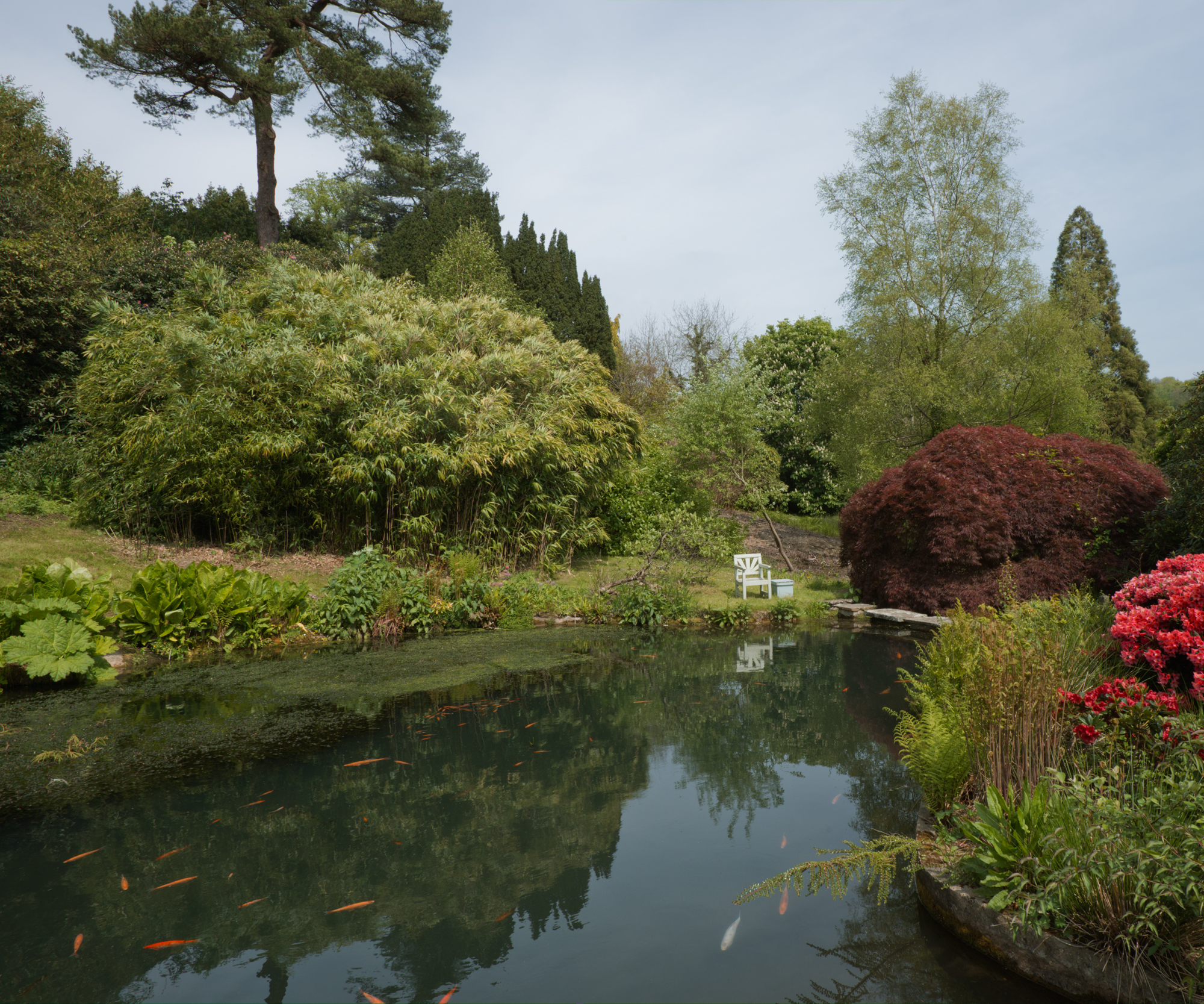
The Goldfish Pool at Chartwell, Westerham 2014 by Leslie Hossack

The Goldfish Pool at Chartwell, Westerham, Kent 2014

© Leslie Hossack

Winston Churchill took up painting in 1915 and it became a life-long passion. Painting relaxed and restored him, and during a period of almost 50 years, he created over 500 pieces. When the family moved into Chartwell in 1924, it became one of Winston’s favourite places to paint. He won his first prize for “Winter Sunshine, Chartwell.” He then sent five paintings to a Paris exhibition in the 1920s. They were shown under the name Charles Morin, and four of them sold for £30 each.

Several of Winston’s paintings remained in the collection of his daughter, Mary. In her book A Daughter’s Tale, The Memoir of Winston Churchill’s Youngest Child (2011), Mary described herself as a Chartwell Child. She went on to play an active role in World War II, and then married Christopher Soames in 1947. Like her mother, Clementine, Mary became a mother of five. Like her father, Winston, Mary became a writer. One of the books he wrote was his father’s biography, Lord Randolph Churchill (1906); one of the books she wrote was her mother’s biography, Clementine Churchill: The Biography of a Marriage (1979).

Mary Soames also wrote Winston Churchill, His Life as a Painter (1990). When Lady Mary Soames, the Churchill’s last surviving child, died in 2014 at the age of 91, some of the paintings from her private collection were auctioned by Sotheby’s. The Goldfish Pool at Chartwell by Winston Churchill sold for almost £1.8m. A photograph of the pool as it appeared in 2014 can be seen above.

The image featured above is part of the limited edition collector’s portfolio created by Leslie Hossack to mark the 50th anniversary of the death of Sir Winston Churchill. She presents locations that chart Churchill’s personal and political life, from his birth at Blenheim Palace in 1874 until his death in London in 1965. THE CHURCHILL PHOTOGRAPHS are part of Hossack’s larger body of work that explores Nazi architecture in Berlin, Stalinist structures in Moscow, contested sites in Jerusalem, a Cold War bunker in Ottawa, NATO’s Headquarter Camp in Kosovo, and buildings linked to the Japanese Canadian internment during World War II.

To view more photographs, please visit Leslie’s website.  lesliehossack.com

Charting Churchill: The Lake at Chartwell

The Lake at Chartwell, Westerham 2014 by Leslie Hossack

The Lake at Chartwell, Westerham, Kent 2014

© Leslie Hossack

By the beginning of the 1920s, Winston Churchill was firmly established in his career. He was a long-time member of the House of Commons and had held three cabinet posts: Secretary of State for War, January 9th 1919 to February 14th 1921; Secretary of State for Air, January 9th 1919 to April 1st 1921; and Secretary of State for the Colonies, February 14th 1921 to October 19th 1922.

However, 1921 was a very difficult year for the family. In January, Clementine’s grandmother, Blanche, the Countess of Airlie, died; in April, her brother, Bill Hozier, committed suicide; and in June, Winston’s mother, Jennie, Lady Randolph Churchill, died. Then, most tragically, Marigold, the Churchills’ two-year-old daughter, died in August of 1921.

A year later, in September 1922, Clementine gave birth to Mary, the Churchills’ last child, and Winston purchased Chartwell, a country home located 25 miles from London. This would remain his beloved retreat for over 40 years, until his death in 1965. At Chartwell, Winston indulged a variety of interests, including exotic butterflies, ornamental fish and black swans. He was actively involved in planning the many water features on the property, such as the lake, shown above. He loved roses and enjoyed the different varieties planted at Chartwell, and he personally built most of the brick walls surrounding the gardens. Bricklaying became another of Winston’s passions.

The image featured above is part of the limited edition collector’s portfolio created by Leslie Hossack to mark the 50th anniversary of the death of Sir Winston Churchill. She presents locations that chart Churchill’s personal and political life, from his birth at Blenheim Palace in 1874 until his death in London in 1965. THE CHURCHILL PHOTOGRAPHS are part of Hossack’s larger body of work that explores Nazi architecture in Berlin, Stalinist structures in Moscow, contested sites in Jerusalem, a Cold War bunker in Ottawa, NATO’s Headquarter Camp in Kosovo, and buildings linked to the Japanese Canadian internment during World War II.

To view more photographs, please visit Leslie’s website.  lesliehossack.com

Charting Churchill: The House at Chartwell

The House at Chartwell, Westerham, Kent 2014 by Leslie Hossack

The House at Chartwell, Westerham, Kent 2014

© Leslie Hossack

The ten years from 1919 to 1929 were a roller coaster ride for Winston Churchill, both politically and personally. After being reelected in Dundee in December 1918, he lost three elections in a row in various ridings, on November 16th 1922, December 6th 1923, and March 19th 1924. From the time of his first election to the House of Commons in 1900, these were his only defeats. On October 29th 1924, he was elected in Epping and went on to win eight consecutive elections before retiring on October 14th 1964.

Winston’s personal life was equally chaotic. From 1915, when the Churchills moved out of Admiralty House, until 1924 when they moved into 11 Downing Street, the official residence of the Chancellor of the Exchequer, the family lived in approximately ten different London homes, several of which were loaned to them by friends or shared with other family members. Also during that time, Winston bought and sold his first country home, Lullenden.

Personal tragedy struck in August 1921, when the Churchills’ two-year-old daughter, Marigold, died of an infection. A year later in September 1922, Mary was born, Winston and Clementine’s last child. Much later, Mary described herself as “the child of consolation.” That same month that she was born, Churchill purchased a country home, Chartwell, shown above. For the rest of his long life, both Mary and Chartwell would bring him great comfort and joy. Mary lived until 2014, when she died at age 91, a daughter of history.

The image featured above is part of the limited edition collector’s portfolio created by Leslie Hossack to mark the 50th anniversary of the death of Sir Winston Churchill. She presents locations that chart Churchill’s personal and political life, from his birth at Blenheim Palace in 1874 until his death in London in 1965. THE CHURCHILL PHOTOGRAPHS are part of Hossack’s larger body of work that explores Nazi architecture in Berlin, Stalinist structures in Moscow, contested sites in Jerusalem, a Cold War bunker in Ottawa, NATO’s Headquarter Camp in Kosovo, and buildings linked to the Japanese Canadian internment during World War II.

To view more photographs, please visit Leslie’s website.  lesliehossack.com

Charting Churchill: State Dining Room, Blenheim Palace

State Dining Room, Blenheim Palace, Woodstock 2014 by Leslie Hossack

State Dining Room, Blenheim Palace, Woodstock 2014

© Leslie Hossack

Winston Churchill visited his grandparents at Blenheim Palace several times for Christmas. In December 1881, when he was seven years old, he wrote to his mother from Blenheim to thank her for his presents. On Christmas Day, perhaps the table in the state dining room looked as it does in the photograph above.

During Sir Winston Churchill’s lifetime (1874 – 1965) the stewardship of Blenheim Palace passed through four Dukes of Marlborough: Winston’s grandfather, John Winston Spencer-Churchill, the 7th Duke; Winston’s uncle, George Charles Spencer-Churchill, the 8th Duke; Winston’s cousin, Charles Richard John (Sunny) Spencer-Churchill, the 9th Duke; and Sunny’s son, John Albert William Spencer-Churchill, the 10th Duke.

In more recent times, John George Vanderbilt Henry Spencer-Churchill became the 11th Duke in 1972. He and his family lived at Blenheim Palace, but only used the state dining room once a year, on Christmas Day. He died in 2014, and was succeeded by his son, Charles James Spencer-Churchill, now the 12th Duke of Marlborough.

The image featured above is part of the limited edition collector’s portfolio created by Leslie Hossack to mark the 50th anniversary of the death of Sir Winston Churchill. She presents locations that chart Churchill’s personal and political life, from his birth at Blenheim Palace in 1874 until his death in London in 1965. THE CHURCHILL PHOTOGRAPHS are part of Hossack’s larger body of work that explores Nazi architecture in Berlin, Stalinist structures in Moscow, contested sites in Jerusalem, a Cold War bunker in Ottawa, NATO’s Headquarter Camp in Kosovo, and buildings linked to the Japanese Canadian internment during World War II.

To view more photographs, please visit Leslie’s website.  lesliehossack.com

Charting Churchill: The Cenotaph, Whitehall, London

The Cenotaph, Whitehall, London 2014 by Leslie Hossack

The Cenotaph, Whitehall, London 2014

© Leslie Hossack

In 1915, Winston Churchill resigned as First Lord of the Admiralty, after the failure of the Dardanelles and Gallipoli campaigns that he had championed. He remained in the cabinet, in the lowly post of Chancellor of the Duchy of Lancaster. He was somewhat despondent but soon, while at Hoe Farm, he took up painting, a pastime that would bring him pleasure for the rest of his life.

However, as always, Winston craved action. In November 1916, when he was a 42-year-old married man with three small children, he resigned from the cabinet and went to France to command the Royal Scots Fusiliers in the trenches. Here he seemed to be seeking solace and redemption. After six months, Churchill returned to London and the House of Commons, still representing Dundee. In July 1917 and in December 1918, he was again elected there.

The year 1918 marked the birth of the Churchills’ fourth child, Marigold Frances. It also signaled the end of Word War I on Armistice Day, November 11th 1918. During the conflict, the British Empire suffered over 1,00,000 military deaths. Fortunately, Winston was not one of them. The Cenotaph, shown above, was completed in 1919 and commemorated the losses during Word War I. Eventually, it was also consecrated to the memory of individuals who died during World War II. Over his long career of public service, in the military and in the House of Commons, Winston Churchill attended many memorial services at the Cenotaph on Whitehall.

The image featured above is part of the limited edition collector’s portfolio created by Leslie Hossack to mark the 50th anniversary of the death of Sir Winston Churchill. She presents locations that chart Churchill’s personal and political life, from his birth at Blenheim Palace in 1874 until his death in London in 1965. THE CHURCHILL PHOTOGRAPHS are part of Hossack’s larger body of work that explores Nazi architecture in Berlin, Stalinist structures in Moscow, contested sites in Jerusalem, a Cold War bunker in Ottawa, NATO’s Headquarter Camp in Kosovo, and buildings linked to the Japanese Canadian internment during World War II.

To view more photographs, please visit Leslie’s website.  lesliehossack.com

Charting Churchill: Admiralty Arch, London

Admiralty Arch, The Mall, London 2014 by Leslie Hossack

Admiralty Arch, The Mall, London 2014

© Leslie Hossack

In October 1911, Winston Churchill was appointed First Lord of the Admiralty. This was a cabinet post that he relished, and in many ways he had been preparing for it throughout his entire life. In this role, Churchill made many significant decisions in the years leading up to the outbreak of World War I, in August 1914. However, in 1915 he proposed the Dardanelles and Gallipoli campaigns that failed and ultimately lead to his resignation as First Lord of the Admiralty in May 1915.

In 1912, early in Churchill’s tenure at the Admiralty, construction of the Admiralty Arch was completed. King Edward VII commissioned the building in memory of his mother, Queen Victoria. The Latin inscription across the top reads: “In the tenth year of King Edward VII, to Queen Victoria, from most grateful citizens, 1910.” During Churchill’s time, Admiralty Arch contained offices and was connected to the Old Admiralty Building via a bridge that can be seen on the right side of the above photograph. To this day, Admiralty Arch provides a ceremonial entrance from Trafalgar Square onto The Mall and along to Buckingham Palace.

The image featured above is part of the limited edition collector’s portfolio created by Leslie Hossack to mark the 50th anniversary of the death of Sir Winston Churchill. She presents locations that chart Churchill’s personal and political life, from his birth at Blenheim Palace in 1874 until his death in London in 1965. THE CHURCHILL PHOTOGRAPHS are part of Hossack’s larger body of work that explores Nazi architecture in Berlin, Stalinist structures in Moscow, contested sites in Jerusalem, a Cold War bunker in Ottawa, NATO’s Headquarter Camp in Kosovo, and buildings linked to the Japanese Canadian internment during World War II.

To view more photographs, please visit Leslie’s website.  lesliehossack.com

Charting Churchill: The Old Admiralty Building, Whitehall, London

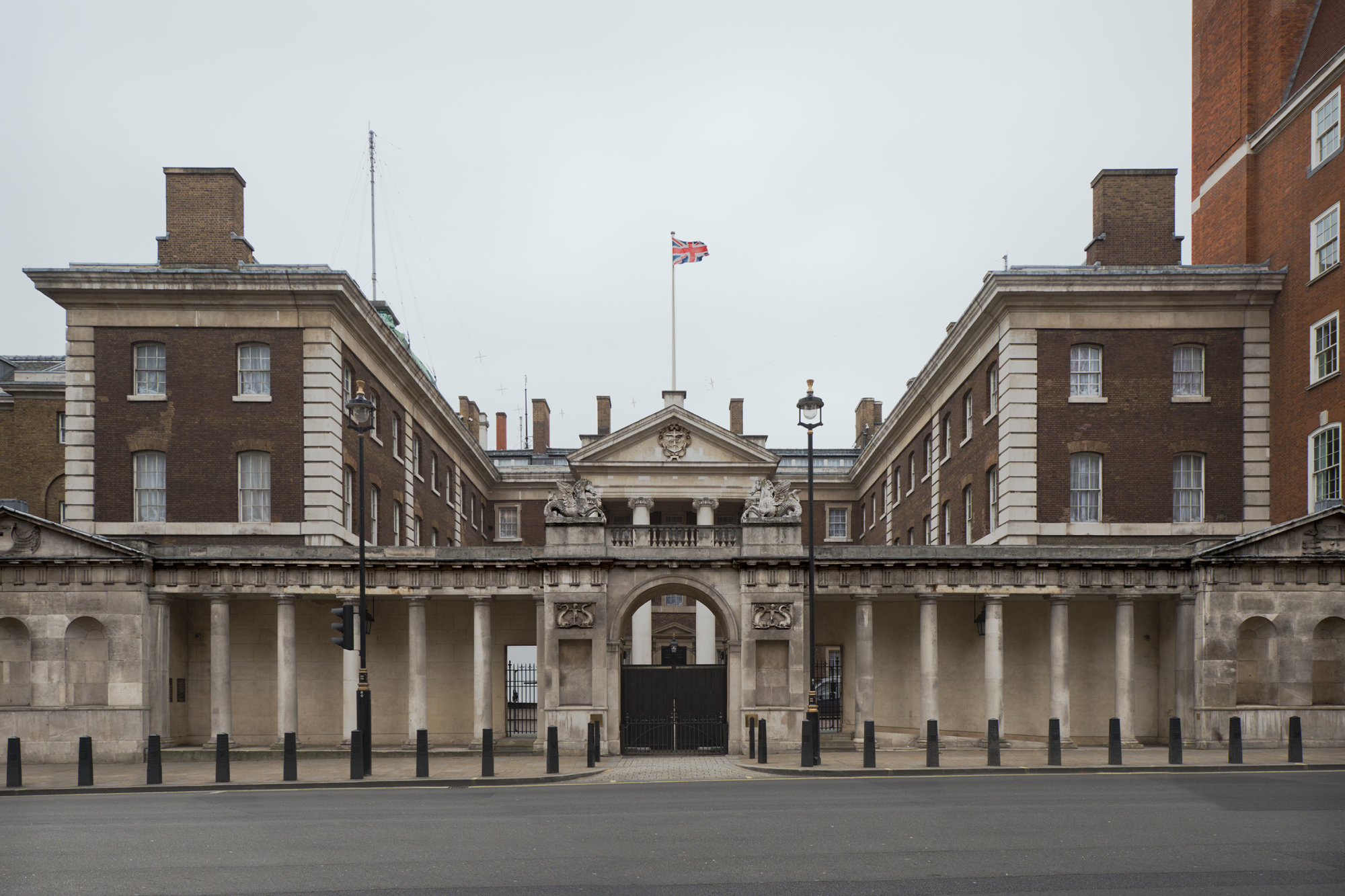
Old Admiralty Building, Whitehall, London 2014 by Leslie Hossack

Old Admiralty Building, Whitehall, London 2014

Winston Churchill was appointed First Lord of the Admiralty on October 25th 1911. He was only 36 years old. This cabinet post brought added responsibilities, opportunities, challenges, influence and status. It also came with an official residence, Admiralty House, which was part of the massive Admiralty complex, seen above from Whitehall. In the spring of 1913, Winston and Clementine, along with their growing family, finally moved into Admiralty House where they lived until May 1915. Sarah Millicent Hermione, their third child, was born here on October 7th 1914, just two months after Great Britain declared war on Germany on August 14th 1914.

From 1911 to 1914, prior to the outbreak of World War I, Churchill worked hard to upgrade the Royal Navy and ready it for war. It was during this time that Winston developed his life-long love of aviation. He took flying lessons and earned the nicknamed The Flying First Lord. After some mishaps, he stopped flying himself, but he did establish the Royal Naval Air Service in preparation for war with Germany.

The image featured above is part of the limited edition collector’s portfolio created by Leslie Hossack to mark the 50th anniversary of the death of Sir Winston Churchill. She presents locations that chart Churchill’s personal and political life, from his birth at Blenheim Palace in 1874 until his death in London in 1965. THE CHURCHILL PHOTOGRAPHS are part of Hossack’s larger body of work that explores Nazi architecture in Berlin, Stalinist structures in Moscow, contested sites in Jerusalem, a Cold War bunker in Ottawa, NATO’s Headquarter Camp in Kosovo, and buildings linked to the Japanese Canadian internment during World War II.

To view more photographs, please visit Leslie’s website.  lesliehossack.com